

Series: Roles Inside a Venture Studio (Part 4 of 4)
Series Navigation:
Part 1: Core Studio Leadership
Part 2: Venture-Building Roles
Part 3: Specialized Support Functions
Part 4: The Studio Operating Model (Current)
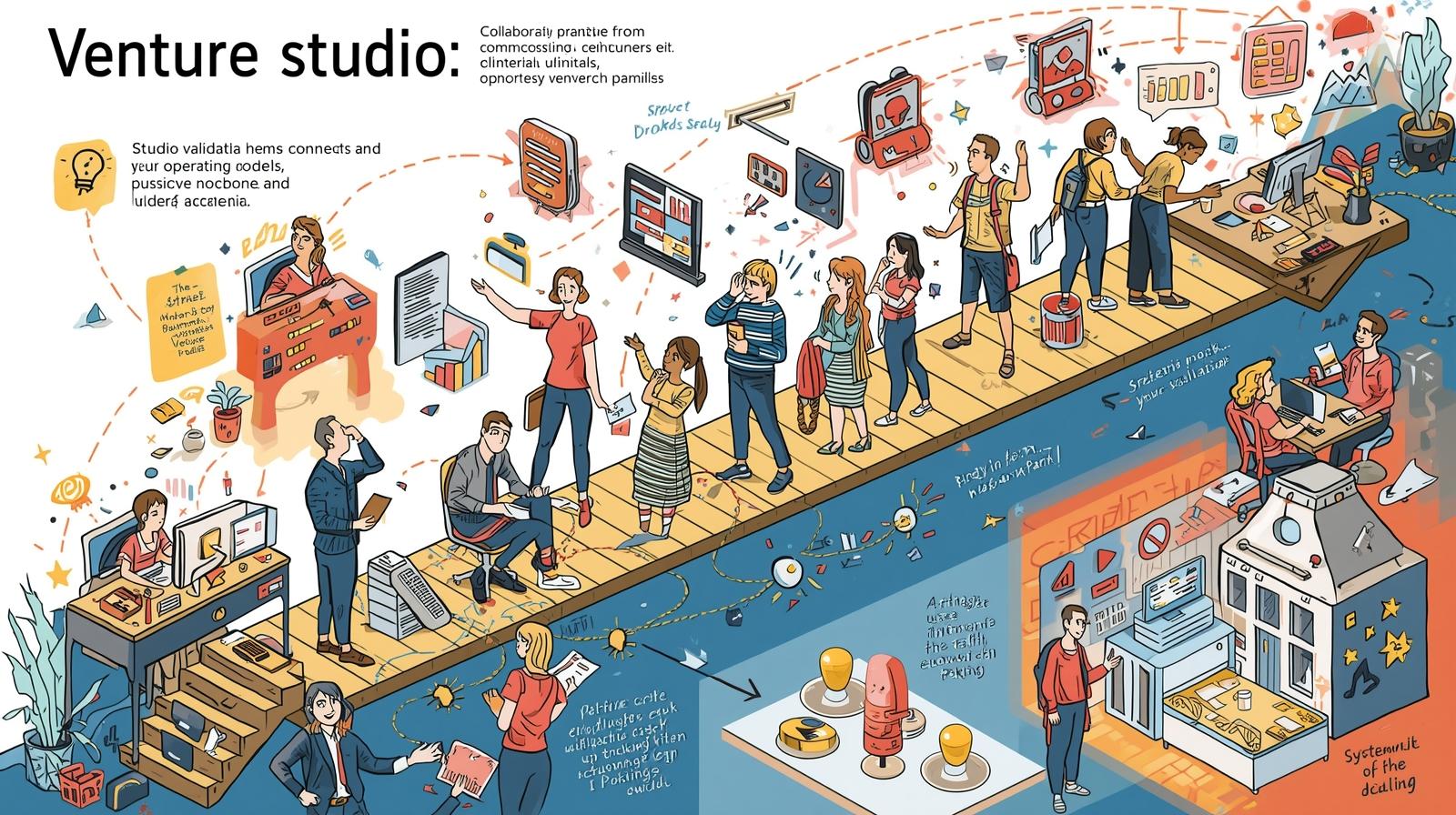
We've explored individual roles—from Managing Partners to Platform Teams. But how do all these people actually work together to build companies?
The magic of venture studios lies not in any single role but in how roles collaborate across the venture lifecycle. Understanding this operating model reveals how studios create their competitive advantage: systematic, repeatable company building.
This is where the studio model comes to life.
For studio operators, this model determines effectiveness. For founders, it explains what to expect. For anyone considering the studio model, it reveals how the machine actually works.
The Venture Lifecycle Operating Model
Studios organize around the venture lifecycle, with different roles engaging at different stages.
Stage 0: Ideation & Thesis Development
Timeline: Ongoing
Primary Roles:
Managing Partner (strategy)
Studio Partners (ideation)
EIRs (exploration)
Operating Partners (domain expertise)
Activities:
Market research and trend analysis
Opportunity identification
Thesis development
Idea generation sessions
Strategic alignment
Outputs:
Investment thesis defined
Opportunity pipeline
Ideas for validation
Strategic priorities
Resource allocation plans
Example weekly activities:
Monday: Partner Meeting
Review market trends
Discuss opportunity areas
Share ideas from network
Prioritize for validation
Wednesday: EIR Check-ins
EIR progress updates
Hypothesis refinement
Resource requests
Direction guidance
Friday: Ideation Session
Team brainstorming
Customer insight sharing
Competitive analysis review
Concept development
Stage 1: Pre-Validation
Timeline: 4-6 weeks per concept
Primary Roles:
Studio Partner (oversight)
EIR or Venture Lead (execution)
Operating Partners (expertise)
Platform team (light support)
Activities:
Secondary research
Expert interviews
Preliminary customer conversations (5-10)
Competitive analysis
Technical feasibility assessment
Outputs:
Validation hypothesis document
Initial customer insights
Go/no-go recommendation
Resource requirements if proceeding
Risk assessment
Example pre-validation week:
Monday:
Kickoff meeting (Studio Partner + EIR)
Define hypotheses to test
Plan research approach
Assign responsibilities
Tuesday-Thursday:
Customer interviews (EIR)
Market research (EIR + support)
Expert consultations (Operating Partner connections)
Competitive analysis (Platform support)
Friday:
Synthesis session
Findings review
Decision preparation
Next steps planning
Investment Committee Review:
Presentation of findings
Critical questioning
Decision: Kill, Pivot, or Advance to Full Validation
Stage 2: Validation
Timeline: 8-12 weeks
Primary Roles:
Studio Partner (active oversight)
EIR or Venture Lead (full-time)
Designers (prototyping)
Engineers (feasibility)
Marketers (demand testing)
Operating Partners (guidance)
Activities:
Extensive customer discovery (20-50 interviews)
Solution concept testing
Prototype or mockup creation
Demand testing (landing pages, etc.)
Business model validation
Willingness-to-pay research
Channel hypothesis testing
Outputs:
Comprehensive validation report
Customer insights and personas
Solution prototype or mockup
Business model canvas
Go-to-market hypothesis
Financial model (preliminary)
Build/no-build recommendation
Example validation week:
Monday:
Team standup (Venture Lead + Platform)
Week priorities
Interview schedule review
Design/engineering alignment
Tuesday-Wednesday:
Customer interviews (Venture Lead)
Prototype iteration (Designer + Engineer)
Demand test refinement (Marketer)
Analysis and synthesis (Venture Lead)
Thursday:
Mid-week review (Studio Partner check-in)
Findings discussion
Hypothesis refinement
Resource needs assessment
Friday:
Team debrief
Documentation update
Next week planning
Learning sharing
Investment Committee Review (Week 12):
Comprehensive presentation
Validation evidence review
Business model discussion
Resource requirements
Decision: Kill, Pivot, or Build MVP
Stage 3: MVP Development & Launch
Timeline: 4-9 months
Primary Roles:
Venture Lead or Founding CEO (leadership)
Studio Partner (regular oversight)
Platform Team (heavy involvement):
Designers (2-3 days/week)
Engineers (full-time equivalent)
Marketer (1-2 days/week)
Talent (founder recruitment if needed)
Operating Partners (specific guidance)
Activities:
MVP product development
Brand and identity creation
Go-to-market strategy execution
Beta customer recruitment
Founder recruitment (if not yet)
Early team building
Launch preparation
Initial sales/pilots
Outputs:
Functional MVP in market
Initial customers (10-50)
Brand identity and website
Go-to-market playbook
Founding team in place
Early revenue (often)
Metrics dashboard
Series of learned insights
Example MVP week structure:
Daily Standup (9am):
Venture Lead + Core Platform Team
Yesterday's progress
Today's plan
Blockers and needs
Monday:
Week planning meeting
Sprint planning (engineering)
Customer feedback review
Priority setting
Wednesday:
Design review
Engineering demo
Marketing check-in
Mid-week adjustment
Friday:
Week retrospective
Demo to Studio Partners
Next week planning
Documentation
Monthly:
Detailed progress review (Managing Partner)
Metrics review
Budget check
Strategic decisions
Resource allocation
Quarterly Investment Committee:
Deep progress review
Metrics and traction
Pivot considerations
Funding decisions (studio capital)
Spin-off timing discussion
Stage 4: Growth & Spin-Off
Timeline: 9-18 months
Primary Roles:
Founding CEO (full ownership)
Studio Partner (board member)
Platform Team (decreasing support):
Talent (executive recruiting)
Finance (fundraising support)
Design/Engineering (specialized needs only)
Marketing (decreasing to zero)
Operating Partners (on-demand)
Activities:
Scale customer acquisition
Build full team (venture hiring)
Refine product-market fit
Prepare for external fundraising
Optimize unit economics
Establish independent operations
Board governance
Path to profitability or next funding
Outputs:
Product-market fit achieved
Independent, functioning company
Full executive team hired
External funding raised (often)
Studio ownership ~20-40%
Board seat maintained
Operational independence
Clear growth trajectory
Example growth stage month:
Weekly (CEO + Studio Partner):
1-hour check-in
Progress and challenges
Strategic discussions
Network introductions
Problem-solving
Monthly:
Board meeting (formal)
Metrics review
Strategic decisions
Fundraising progress
Team updates
Quarterly:
Strategic planning session
Major decisions
Resource needs
Exit pathway discussion
Platform Team:
Ad hoc support only
Specific requests
No dedicated allocation
On-demand expertise
Stage 5: Independence
Timeline: Months 24-36+
Primary Roles:
Founding CEO (complete ownership)
Studio Partner (board member only)
Platform Team (rare/none)
Activities:
Full independent operation
Continued growth
Additional fundraising rounds
Market expansion
Team scaling
Exit preparation (eventual)
Studio Involvement:
Quarterly board meetings
Strategic moments only
Network when valuable
Exit planning
Special situations
This is success: the venture no longer needs the studio.
Resource Allocation Framework
How studios decide which ventures get which resources when.
Allocation Principles
1. Stage-Based Allocation
Pre-validation:
Minimal resources
1 person primarily (EIR or Studio Partner)
Platform support very light
Low studio commitment
Validation:
Light resources
1-2 people full-time
Platform support part-time
Medium studio commitment
MVP Building:
Heavy resources
Full venture team
Platform heavily involved
High studio commitment
Growth:
Decreasing resources
Venture builds own team
Platform support decreasing
Transitioning commitment
Independence:
Minimal resources
Venture self-sufficient
On-demand only
Low studio commitment
2. Portfolio Prioritization
Factors determining priority:
Strategic Importance:
Thesis alignment
Market timing
Competitive urgency
Portfolio balance
Stage and Momentum:
Further along = higher priority
Positive signals = more resources
Struggling ventures = tough decisions
Kill or double-down
Resource Efficiency:
Which ventures use resources well
Team effectiveness
Execution quality
Learning generation
Expected Outcomes:
Potential venture value
Probability of success
Studio returns
Strategic value
Capacity Planning
How studios manage finite resources:
Platform Team Capacity:
Example studio with 5 active ventures:
Design Team (3 designers):
Venture A: 3 days/week (building MVP)
Venture B: 2 days/week (building MVP)
Venture C: 2 days/week (post-launch iteration)
Venture D: 1 day/week (maintenance)
Venture E: 1 day/week (early validation)
Studio work: 1 day/week (systems, tools)
Total: 10 days/week capacity
Engineering Team (8 engineers):
Venture A: 3 engineers (full-time on MVP)
Venture B: 3 engineers (full-time on MVP)
Venture C: 1 engineer (maintenance, features)
Venture D: 0.5 engineer (bug fixes)
New ventures: 0.5 engineer (prototypes)
Platform: 1 engineer (internal tools)
Total: 8 FTE
When at capacity:
New ventures wait
Or hire additional platform team
Or outsource specific work
Or kill lower-priority ventures
Decision-Making Process
Weekly Resource Allocation Meeting:
Attendees:
VP Engineering
Design Lead
Marketing Lead
Studio Partners
Agenda:
Review current allocation
Discuss venture requests
Assess capacity
Prioritize work
Assign resources
Flag capacity issues
Outputs:
Updated allocation plan
Clear commitments
Declined requests (with reasoning)
Hiring needs identified
Communication & Coordination Rhythms
How studios maintain alignment across complex portfolios.
Daily Rituals
Venture Team Standups (9am):
Each active venture
15 minutes
Core team only (Lead + Platform)
Yesterday/today/blockers
Quick coordination
Platform Team Standups (9:30am):
Each functional team
Engineering, Design, Marketing
Coordinate across ventures
Resource conflicts
Technical issues
Weekly Rituals
Monday: Week Planning
Venture team planning meetings
Set week priorities
Align on deliverables
Resource confirmation
Wednesday: Studio Partner Check-ins
30-60 min per venture
Progress review
Problem-solving
Guidance
Resource needs
Friday: Week Review
Venture team retrospectives
What worked/didn't work
Learning capture
Next week planning
Demos to broader team
Friday: Studio Team Meeting
All partners + platform leads
Portfolio status
Resource challenges
Cross-venture learning
Upcoming decisions
Monthly Rituals
Portfolio Review Meeting:
All partners
2-4 hours
Deep dive each venture
Metrics review
Strategic discussions
Resource reallocation
Investment Committee:
Monthly or as needed
Validation reviews
Build decisions
Major pivots
Funding allocations
All-Hands Meeting:
Entire studio team
Portfolio updates
Celebrate wins
Share learnings
Build culture
Quarterly Rituals
Strategic Planning:
Partners + senior leads
Full day session
Studio strategy review
Portfolio composition
Resource planning
Process improvements
Market trends
Annual planning alignment
Board Meetings (Per Venture):
Venture CEO + Studio board members
Formal governance
Metrics and progress
Strategic decisions
Funding discussions
Team and hiring
Challenges and support
Venture Reviews:
Deep dive analysis
Metrics trends
Market position
Competitive dynamics
Strategic options
Continue/pivot/kill decisions
Annual Rituals
Annual Planning:
Multi-day session
Studio goals and strategy
Capital deployment plans
Team expansion
Process evolution
Success metrics
Long-term vision
Portfolio Company Offsites:
Bring all portfolio CEOs together
Share learnings
Build community
Strategic discussions
Network development
How Teams Collaborate in Practice
Real examples of cross-functional collaboration.
Example 1: New Venture Launch
Scenario: Studio validates B2B SaaS opportunity, moving to MVP build
Week 1: Kickoff
Monday Kickoff Meeting (3 hours):
Attendees: Studio Partner, Venture Lead, Design Lead, Engineering Lead, Marketing Lead, Talent Partner
Agenda:
Vision and strategy alignment
Success metrics definition
Timeline and milestones
Resource allocation
Roles and responsibilities
Communication rhythms
Outputs: Project plan, team assignments, first sprint defined
Week 2-4: Initial Build
Daily standups: Venture Lead + assigned designers/engineers
Weekly check-ins: Studio Partner + Venture Lead
Activities:
Design: User flows, wireframes, visual design
Engineering: Architecture decisions, infrastructure setup, first features
Marketing: Brand identity, messaging framework, website wireframes
Talent: Begin founder search (if external)
Week 5-8: MVP Development
Intensifying collaboration:
Design + Engineering: Daily pairing on implementation
Marketing + Design: Brand rollout coordination
Venture Lead + Studio Partner: Strategic decisions
Talent: Founder interviews and assessment
Week 9-12: Launch Preparation
Cross-functional intensive:
Final QA and testing
Marketing campaign preparation
Sales materials creation
Beta customer outreach
Launch planning
Founder onboarding (if recruited)
Launch Week:
Daily war room
All hands on deck
Rapid iteration
Close monitoring
Quick problem-solving
Example 2: Venture Struggling with Product-Market Fit
Scenario: 6 months post-launch, traction below expectations
Month 7: Problem Recognition
Studio Partner identifies:
Churn too high
Acquisition too slow
Engagement weak
Unit economics poor
Initial actions:
Deep customer interviews (Venture Lead + Design)
Analytics deep dive (Engineering)
Competitive repositioning (Marketing)
Operating Partner consultation (Product + GTM)
Month 8: Diagnosis and Strategy
Investment Committee Session:
Present findings
Diagnose core issues
Debate options: Pivot vs. Kill vs. Persevere
Decision: Targeted pivot to new customer segment
Resource reallocation:
Add senior product designer (Platform)
Bring in GTM Operating Partner (weekly)
Increase Studio Partner time (2x/week)
Pause growth marketing spend
Month 9-11: Pivot Execution
Intensive collaboration:
Redesign for new segment (Design + Engineering)
Rebuild messaging (Marketing)
New customer discovery (Venture Lead + Design)
Sales playbook revision (GTM Operating Partner)
Month 12: Pivot Assessment
Evaluation:
New metrics review
Customer feedback analysis
Unit economics check
Continue or kill decision
Example 3: Successful Venture Scaling
Scenario: Product-market fit achieved, time to scale and spin off
Quarter 1: Transition Planning
Studio Partner + CEO planning:
Hiring roadmap
Fundraising strategy
Independence timeline
Platform team transition
Board governance
Talent team engagement:
Executive search (VP Engineering, VP Sales, VP Marketing)
Compensation framework
Recruiting process support
Quarter 2: Team Building
Platform support:
Design: Train new designer hired by venture
Engineering: Onboard new engineering hires
Marketing: Transition campaigns to venture marketer
Operations: Setup independent systems
Decreasing involvement:
Platform team gradually steps back
Venture team takes over
Knowledge transfer focus
Documentation critical
Quarter 3: Fundraising
Studio support:
Finance Operating Partner: Model refinement
Managing Partner: Investor introductions
Studio Partner: Pitch development support
Platform team: Minimal (venture self-sufficient)
Quarter 4: Independence
Final transition:
Series A closed
Full executive team in place
Studio board seat established
Platform team fully hands off
Monthly → Quarterly check-ins
Independence achieved
Studio Team Scaling
How studios grow their teams as portfolios expand.
Studio Lifecycle Stages
Stage 1: Early Studio (Years 1-2)
Team Size: 10-20 people
Composition:
1-2 Managing Partners
2-3 Studio Partners
5-8 Platform team
2-3 EIRs or Venture Leads
1-2 Operations
Portfolio: 1-3 active ventures
Model:
Hands-on everything
Partners doing platform work
Scrappy and lean
Learning and iteration
Building playbooks
Stage 2: Growing Studio (Years 3-5)
Team Size: 25-40 people
Composition:
2-3 Managing Partners
4-6 Studio Partners
3-5 Operating Partners
15-20 Platform team
3-5 Venture Leads/EIRs
3-5 Operations
Portfolio: 5-8 active ventures
Model:
Specialized roles emerging
Clear processes established
Platform team structured
Operating partners brought in
Scaling systems
Stage 3: Mature Studio (Years 5+)
Team Size: 40-60+ people
Composition:
3-4 Managing Partners
6-10 Studio Partners
6-10 Operating Partners
25-35 Platform team
5-8 Venture Leads/EIRs
5-8 Operations
Portfolio: 10-15 active ventures, 15-30 total created
Model:
Institutional organization
Clear career paths
Strong culture
Process excellence
Knowledge management
Brand and reputation
Hiring Triggers
When to hire:
Platform team:
Utilization consistently >90%
Ventures waiting for resources
Quality suffering
Opportunity cost high
Studio Partners:
Managing Partner overwhelmed
Portfolio complexity increasing
New specializations needed
Vertical expansion
Operating Partners:
Common expertise gaps across portfolio
External expertise needed repeatedly
Value clearly demonstrated
Network access critical
Operations:
Admin burden slowing team
Financial complexity increasing
Legal needs expanding
Systems breaking
Span of Control Guidelines
Managing Partner:
4-6 Studio Partners (max)
10-15 total ventures (portfolio)
Studio Partner:
2-4 active ventures
3-5 platform team members
Platform Lead:
4-6 individual contributors
3-5 ventures served
Venture Lead:
3-5 platform team members
1 venture (full focus)
Success Metrics for Studio Operations
How to measure if the operating model is working.
Efficiency Metrics
Resource Utilization:
Platform team capacity used (target: 85-90%)
Cost per venture
Time to MVP
Ventures per partner
Process Metrics:
Validation cycle time (target: 8-12 weeks)
Time from validation to launch (target: 6-9 months)
Kill rate (target: 60-80% of ideas)
Pivot frequency
Quality Metrics
Venture Outcomes:
% achieving product-market fit
% raising external capital
% reaching profitability
Exit rate and multiples
Team Metrics:
Employee retention
Platform team satisfaction
Founder satisfaction
Culture health
Learning Metrics
Institutional Knowledge:
Playbooks created
Processes documented
Success rate improving
Cycle time decreasing
Cost per venture decreasing
Common Operating Model Challenges
Problems studios face and solutions.
Challenge 1: Resource Contention
Problem: Multiple ventures need same resources simultaneously
Solutions:
Clear prioritization framework
Capacity planning discipline
Hire before critical
Outsource tactical work
Kill lower-priority ventures
Challenge 2: Context Switching
Problem: Platform team constantly switching between ventures
Solutions:
Batch similar work
Dedicate people to ventures
Minimize unnecessary meetings
Clear focus time
Efficient handoffs
Challenge 3: Knowledge Transfer
Problem: Platform team knowledge doesn't transfer to ventures
Solutions:
Document everything
Pair with venture hires
Training programs
Office hours model
Gradual handoff
Challenge 4: Founder-Studio Tension
Problem: Conflict over control and decision-making
Solutions:
Clear governance from start
Explicit decision rights
Regular alignment sessions
Studio Partner relationship skills
Conflict resolution processes
Challenge 5: Scaling Challenges
Problem: Operating model breaks as portfolio grows
Solutions:
Proactive process development
Hire ahead of pain
Build infrastructure early
Continuous improvement culture
Learn from best studios
Conclusion: Operations as Competitive Advantage
The studio that executes its operating model best wins.
Key Takeaways:
Lifecycle Engagement: Different roles engage at different stages. Platform heavy early, decreasing over time.
Resource Allocation: Systematic prioritization and capacity planning. Stage-based allocation. Portfolio thinking.
Communication Rhythms: Daily, weekly, monthly, quarterly cadences. Clear, consistent coordination. Alignment without overhead.
Collaboration Patterns: Cross-functional teams for ventures. Platform support model. Knowledge transfer critical.
Scaling Approach: Grow team with portfolio. Hire ahead of pain. Build systems early. Improve continuously.
Success metrics:
Venture outcomes improving
Efficiency increasing
Quality maintained
Team satisfied
Knowledge accumulating
The outcome: Studios with excellent operating models can build more companies, faster and better, with better outcomes—creating systematic competitive advantage through operational excellence.
The best studios don't just have smart people—they have smart systems for how those people work together.
Series Complete!
Series Navigation:
Part 1: Core Studio Leadership
Part 2: Venture-Building Roles
Part 3: Specialized Support Functions
Part 4: The Studio Operating Model (Current)
References
Note: This article synthesizes operating models from leading venture studios, drawing from public information about studio operations, organizational structures, and best practices in venture building.
Explore venture studios: Visit VentureStudiosHub.com to discover how studios operate and career opportunities.