

Series: Roles Inside a Venture Studio (Part 1 of 4)
Series Navigation:
Part 1: Core Studio Leadership (Current)
Part 2: Venture-Building Roles
Part 3: Specialized Support Functions
Part 4: The Studio Operating Model

Walk into a venture studio and you'll encounter a fundamentally different organizational structure than traditional venture capital firms or startup incubators.
While VCs have investment partners and startups have founders and employees, venture studios require a unique blend of roles—part investor, part operator, part entrepreneur, part consultant. These roles work together to systematically build multiple companies simultaneously.
Understanding who does what inside a venture studio reveals how the model actually works.
This organizational structure is what enables studios to validate ideas, build products, recruit founders, and launch companies at scale. The wrong team structure leads to chaos, bottlenecks, and failed ventures. The right structure creates a machine for repeatable company creation.
This series explores the complete roster of roles inside venture studios. In this first part, we'll examine the core leadership positions that define studio strategy and operations.
The Venture Studio Organizational Philosophy
Before diving into specific roles, it's important to understand how studios think about organization differently.
How Studios Are Different
Traditional VC Firm:
Small team (5-15 people)
Investment professionals
Deal sourcing and diligence
Board-level involvement only
Capital providers
Traditional Startup:
Single company focus
Founder-led
Building one product
Full vertical integration
Hiring for growth
Venture Studio:
Medium-sized team (15-50+ people)
Multiple companies simultaneously
Hands-on building and operations
Pre-founder and post-founder involvement
Capital + capabilities provider
The studio must be structured to build, not just fund.
Key Organizational Principles
1. Shared Resources Across Portfolio
Studios create centralized capabilities:
Technical development
Design and product
Marketing and brand
Talent and recruiting
Legal and finance
These resources serve multiple ventures, creating efficiency.
2. Stage-Based Involvement
Roles engage at different stages:
Some focused on early validation
Others on building and launch
Some on growth and scaling
Transitions as ventures mature
3. Matrix Organization
People often serve:
Studio operations AND
Specific ventures
Multiple ventures simultaneously
Studio evolution projects
More complex than single-company structure.
4. Temporary vs. Permanent
Permanent studio roles:
Core leadership
Platform team
Shared services
Temporary/transitional roles:
Venture leads (become founders)
Interim executives
Project-based contributors
5. Build to Spin Off
Ultimate goal:
Ventures become independent
Founders take over fully
Studio role diminishes
Independence achieved
Studios build themselves out of jobs successfully.
Role 1: Managing Partner (Studio CEO)
The Managing Partner leads the entire studio and owns ultimate success.
Primary Responsibilities
Strategic Direction:
Define studio thesis and focus
Set portfolio strategy
Allocate capital across ventures
Make final go/no-go decisions
Determine studio evolution
Studio Building:
Recruit senior leadership
Build studio culture
Develop processes and playbooks
Create institutional knowledge
Scale studio operations
External Relationships:
Raise studio capital
Manage investor relations
Build corporate partnerships
Develop ecosystem relationships
Represent studio publicly
Portfolio Oversight:
Review venture progress
Guide critical decisions
Connect ventures to resources
Manage venture transitions
Drive exits and outcomes
Team Leadership:
Set studio priorities
Manage team performance
Resolve conflicts
Develop talent
Build high-performing organization
Key Skills and Background
Typical Managing Partner profile:
Entrepreneurial Experience:
Founded and scaled companies
Operated in C-suite roles
Built teams and products
Navigated growth challenges
Experienced exits
Investment Acumen:
Portfolio management
Capital allocation
Deal structuring
Exit strategy
Financial modeling
Organizational Leadership:
Built and scaled teams
Created processes and systems
Managed complex organizations
Developed culture
Led through change
Industry Expertise:
Deep knowledge in studio focus area
Network and relationships
Market understanding
Competitive intelligence
Trend awareness
Most Managing Partners have founded companies, operated at senior levels, and have investor experience.
Day-to-Day Activities
Strategic (40%):
Review venture performance
Make investment decisions
Set strategic priorities
Allocate resources
Guide major pivots
External (30%):
Investor meetings
Partner development
Network building
Public speaking
Ecosystem engagement
Team (20%):
Leadership meetings
One-on-ones with key people
Conflict resolution
Culture building
Talent decisions
Operational (10%):
Process improvement
Studio operations
Systems development
Knowledge capture
Relationship to Ventures
Before Incorporation:
Approves idea validation
Reviews validation findings
Makes build/kill decisions
Allocates studio resources
During Building:
Periodic progress reviews
Available for guidance
Helps recruit founders
Connects to network
Post-Launch:
Board member typically
Strategic counsel
Quarterly reviews
Exit planning
Not day-to-day involved unless critical.
Success Metrics
Managing Partners measured on:
Portfolio company outcomes
Capital deployed and returned
Studio reputation and brand
Team quality and retention
Institutional knowledge built
Fundraising success
Studio financial performance
Common Challenges
1. Scaling Attention
Can't be deeply involved in all ventures
Must delegate effectively
Trust team judgment
Focus on highest leverage
2. Context Switching
Multiple ventures, different stages
Studio operations + portfolio
Internal + external demands
Strategic + tactical needs
3. Knowing When to Intervene
When to get involved vs. stay back
How directive to be
Balancing control and autonomy
Empowering team while staying informed
4. Building Institution
Moving from personal to institutional
Capturing tacit knowledge
Creating systems not dependencies
Developing next generation
 Role 2: Studio Partners (Investment Partners)
Studio Partners typically focus on specific functions or stages of the venture building process.
Common Studio Partner Specializations
Partner, Ideation & Validation:
Lead idea generation
Oversee validation processes
Manage EIR program
Make advancement recommendations
Build validation playbooks
Partner, Venture Building:
Oversee MVP development
Manage pre-founder building
Coordinate studio resources
Ensure quality and speed
Launch preparation
Partner, Talent & Founders:
Recruit founders
Assess founder candidates
Match founders to opportunities
Support founder onboarding
Manage founder relationships
Partner, Growth & Scale:
Help ventures scale post-launch
Guide fundraising processes
Support growth strategies
Prepare for independence
Manage transitions
Partner, [Vertical Expertise]:
Deep expertise in focus industry
Generate vertical-specific ideas
Validate in specialized markets
Build industry relationships
Guide domain decisions
Primary Responsibilities
Venture Oversight:
Directly involved in portfolio companies
Regular progress reviews
Guidance and problem-solving
Resource coordination
Quality assurance
Process Development:
Build repeatable playbooks
Improve efficiency
Capture learnings
Train team members
Institutionalize knowledge
Team Management:
Lead functional teams
Develop junior talent
Coordinate across ventures
Ensure execution quality
Build capabilities
Strategy Contribution:
Inform studio strategy
Recommend new approaches
Identify market opportunities
Competitive intelligence
Trend analysis
Key Skills and Background
Domain Expertise:
Deep knowledge in specialization
Track record in area
Network and relationships
Credibility with founders
Current market understanding
Operational Experience:
Built and scaled teams
Led functions or businesses
Navigated 0-to-1 journey
Solved real problems
Executed under uncertainty
Coaching Ability:
Guide without controlling
Develop others
Transfer knowledge
Ask good questions
Build confidence
Pattern Recognition:
See across portfolio
Identify common challenges
Learn from failures
Apply lessons broadly
Build frameworks
Day-to-Day Activities
Venture Support (50%):
Check-ins with venture leads
Problem-solving sessions
Resource coordination
Quality reviews
Guidance and coaching
Team Development (20%):
Team meetings
One-on-ones
Training and development
Process improvement
Knowledge sharing
Studio Operations (20%):
Partner meetings
Strategy sessions
Investment committee
Portfolio reviews
Planning
External Engagement (10%):
Network building
Industry events
Founder recruiting
Partner development
Learning and research
Relationship to Ventures
More hands-on than Managing Partner:
During validation:
Regular involvement
Direct guidance
Review sessions
Decision input
During building:
Weekly check-ins
Active problem-solving
Resource provision
Quality oversight
Post-launch:
Monthly/quarterly reviews
Available for issues
Network connections
Strategic guidance
Gradually decrease involvement as venture matures.
Role 3: Operating Partners
Operating Partners provide deep functional expertise across the portfolio.
Common Operating Partner Functions
Operating Partner, Product:
Product strategy guidance
Roadmap development
User experience expertise
Product-market fit assessment
Feature prioritization frameworks
Operating Partner, Engineering:
Technical architecture guidance
Technology stack decisions
Engineering best practices
CTO recruiting and assessment
Technical diligence
Operating Partner, Go-to-Market:
GTM strategy development
Channel strategy
Sales playbook creation
Marketing frameworks
Growth strategies
Operating Partner, Finance:
Financial modeling
Unit economics analysis
Fundraising preparation
Cap table management
Board reporting
Operating Partner, Talent:
Recruiting strategies
Founder matching
Executive search
Talent assessment
Compensation frameworks
Primary Responsibilities
Functional Expertise:
Deep knowledge in domain
Best practices and frameworks
Trend awareness
Tool and technology knowledge
Network in function
Portfolio Support:
Available to all ventures
Consistent guidance
Problem-solving
Resource connections
Quality standards
Capability Building:
Develop playbooks
Train venture teams
Build institutional knowledge
Create repeatable processes
Scale expertise
Network Leverage:
Connect ventures to experts
Facilitate partnerships
Enable customer intros
Recruit talent
Access resources
Key Skills and Background
Functional Mastery:
10+ years in specialty
Senior roles (VP, C-level)
Built and scaled functions
Industry recognition
Proven track record
Startup Experience:
Worked in early-stage companies
0-to-1 building experience
Scaled through growth
Navigated constraints
Practical, not just theoretical
Teaching Ability:
Transfer knowledge effectively
Adapt to different contexts
Mentor and develop
Create frameworks
Document learnings
Pattern Recognition:
See across companies
Identify commonalities
Build playbooks
Apply lessons
Continuous improvement
Day-to-Day Activities
Venture Consulting (60%):
Office hours for ventures
Specific problem-solving
Review and feedback
Guidance on decisions
Resource connections
Knowledge Building (25%):
Playbook development
Training creation
Best practices documentation
Tool evaluation
Process improvement
Network Development (10%):
Industry connections
Expert relationships
Partner development
Community engagement
Continuous learning
Team Collaboration (5%):
Partner meetings
Cross-functional projects
Studio initiatives
Knowledge sharing
Relationship to Ventures
On-demand expertise:
Engagement model:
Available when needed
Office hours or scheduled sessions
Specific problem focus
Not daily involvement
Scales across portfolio
Example interactions:
Product Partner reviews roadmap quarterly
Engineering Partner advises on architecture decisions
GTM Partner helps design sales process
Finance Partner models funding scenarios
Talent Partner sources executive candidates
Depth when needed, breadth across portfolio.
Role 4: Platform Team (Shared Services)
The Platform Team provides centralized capabilities that serve all ventures.
Platform Team Structure
Design Team:
Brand development
Product design
User research
UI/UX creation
Design systems
Engineering Team:
MVP development
Technical prototyping
Architecture design
Code quality
DevOps and infrastructure
Marketing Team:
Demand generation
Content creation
Brand building
PR and communications
Growth marketing
Talent Team:
Founder recruiting
Executive search
Team building support
Compensation guidance
Culture development
Operations Team:
Legal support
Finance and accounting
HR administration
IT and systems
Office management
Primary Responsibilities
Venture Support:
Provide services to portfolio companies
Build products and capabilities
Execute on behalf of ventures
Fill gaps in venture teams
Enable faster launches
Quality Maintenance:
Ensure consistent standards
Professional execution
Best practices application
Brand consistency
Institutional quality
Efficiency Creation:
Shared resources reduce costs
Faster execution through experience
Learning across portfolio
Economies of scale
Resource optimization
Knowledge Capture:
Document best practices
Build templates and frameworks
Create reusable assets
Institutionalize learnings
Train venture teams
Engagement Model
Early Stage:
Heavy platform involvement
Studio builds with platform team
Ventures lean on resources
Full support provided
Growth Stage:
Venture hires own team
Platform provides guidance
Transition of capabilities
Decreasing reliance
Independent Stage:
Minimal platform involvement
Venture fully self-sufficient
Available for specific needs
Relationship maintained
Platform builds, then hands off to ventures.
Team Composition
Senior practitioners:
Experienced in their craft
Startup background
Portfolio mindset
Teaching oriented
Efficient executors
Ratio typically:
1 designer per 2-3 active ventures
2-3 engineers per active venture
1 marketer per 3-4 ventures
Talent team serves entire portfolio
Operations team serves entire studio
Scales with portfolio size.
Key Challenges
1. Allocation Across Ventures
Which venture gets resources when?
Balancing competing demands
Priority setting
Capacity management
Fair distribution
2. Quality vs. Speed
Good enough vs. perfect
MVP mentality
Knowing when to invest more
Accepting venture trade-offs
Building for flexibility
3. Building to Hand Off
Create, then release control
Train venture teams
Document decisions
Enable independence
Avoid dependency
4. Context Switching
Multiple different ventures
Various stages and needs
Different industries
Switching costs
Mental overhead
How Core Roles Work Together
The magic happens in collaboration, not individual roles.
Investment Committee
Membership:
Managing Partner (chair)
Studio Partners
Operating Partners (invited for expertise)
Sometimes external advisors
Purpose:
Review validation findings
Make go/no-go decisions
Allocate studio resources
Approve founder matches
Monitor portfolio health
Cadence:
Monthly or bi-weekly
As needed for urgent decisions
Formal review process
Documented decisions
Operating Rhythm
Weekly Studio Meeting:
All partners and senior platform leads
Portfolio status updates
Resource allocation discussions
Problem-solving
Coordination
Monthly Portfolio Review:
Deep dive on each venture
Metrics and progress
Strategic discussions
Adjustments and pivots
Resource needs
Quarterly Strategic Planning:
Studio strategy review
Portfolio composition
Resource planning
Process improvements
Market trends
Annual Planning:
Studio goals and priorities
Capital deployment plans
Team expansion
Process evolution
Strategic initiatives
Decision-Making Framework
Managing Partner owns:
Studio strategy and direction
Capital deployment
Senior hiring
Major portfolio decisions
External positioning
Studio Partners own:
Day-to-day venture decisions
Resource allocation execution
Process development
Team management
Functional strategies
Operating Partners own:
Functional best practices
Playbook development
Expertise application
Network leverage
Knowledge capture
Platform Team owns:
Execution and delivery
Quality standards
Service provision
Capability building
Operational excellence
Clear ownership with coordination.
Studio Team Sizing
How many people in each role?
By Studio Size
Small Studio (15-25 people):
1 Managing Partner
2-3 Studio Partners
2-3 Operating Partners (part-time often)
10-15 Platform Team
Supporting 3-5 active ventures
Medium Studio (25-40 people):
1-2 Managing Partners
4-6 Studio Partners
4-6 Operating Partners
15-25 Platform Team
Supporting 5-10 active ventures
Large Studio (40-60+ people):
2-3 Managing Partners
6-10 Studio Partners
6-10 Operating Partners
25-40 Platform Team
Supporting 10-15 active ventures
By Studio Model
Vertical Studio:
Fewer partners (deep expertise)
Larger platform team (reusable assets)
More operating partners (domain specialists)
Higher venture-to-staff ratio
Horizontal Studio:
More partners (diverse expertise)
Smaller platform team (less reuse)
Fewer operating partners (generalists)
Lower venture-to-staff ratio
The model determines optimal sizing.
Compensation and Incentives
How core roles are compensated:
Managing Partner
Typical structure:
Market-rate salary
Significant studio equity (20-40%)
Carried interest in portfolio (20-30%)
Long-term vesting (4+ years)
Performance bonuses
Studio Partners
Typical structure:
Competitive salary
Studio equity (2-10% each)
Carried interest allocation
Performance bonuses
Venture equity sometimes
Operating Partners
Typical structure:
Senior-level salary
Studio equity (0.5-3%)
Carried interest participation
Performance bonuses
Consulting fees sometimes
Platform Team
Typical structure:
Market-rate salaries
Studio equity grants (0.1-1%)
Performance bonuses
Venture equity rarely
Benefits and perks
Alignment through studio success + portfolio outcomes.
Conclusion: Leadership Creates Studio Success
The core leadership and platform roles define what a venture studio can achieve.
Key Takeaways:
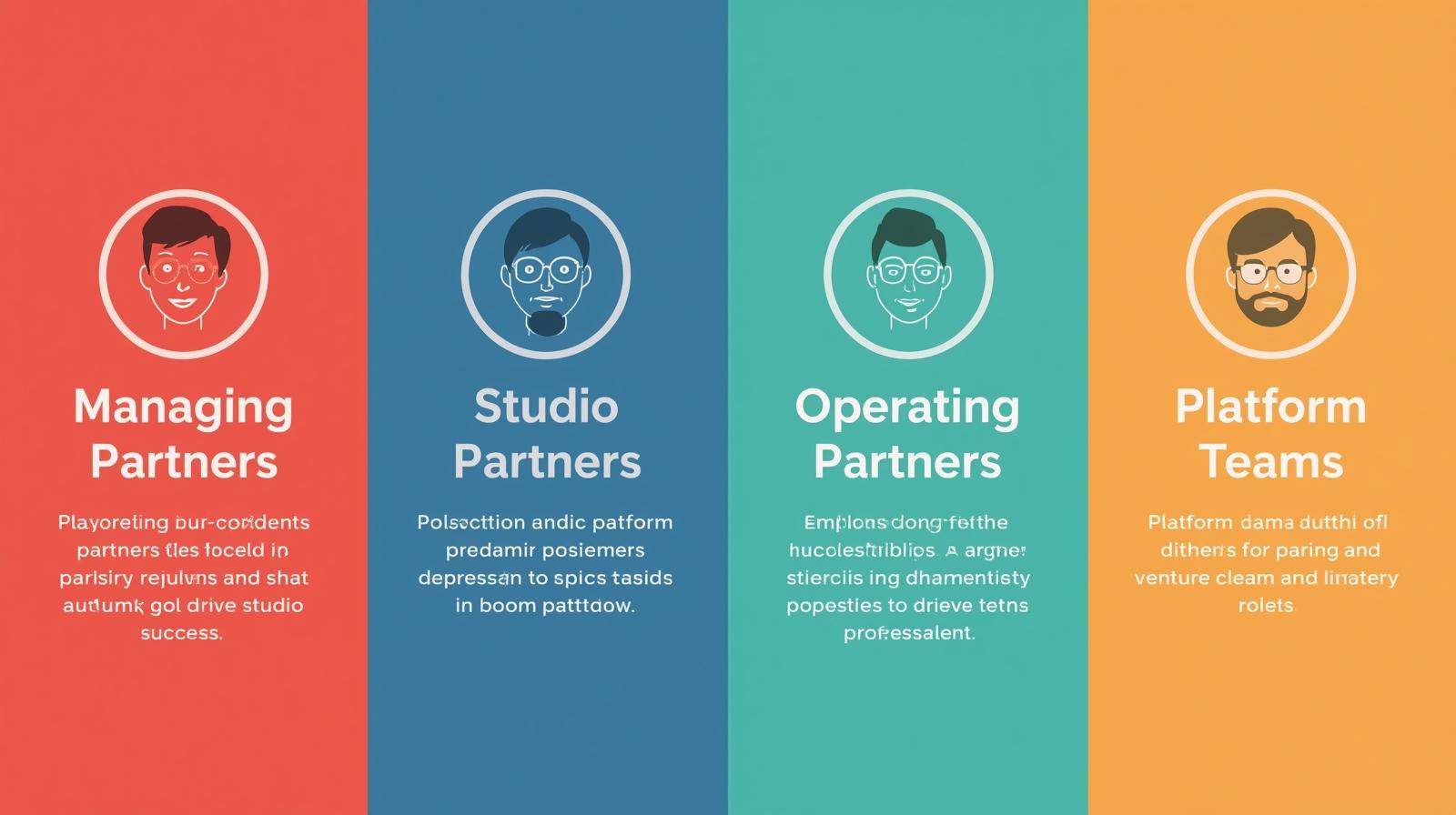
Managing Partner: Sets strategy, builds studio, manages portfolio, represents externally. CEO of the studio itself.
Studio Partners: Oversee specific functions or stages. Hands-on with ventures, develop processes, manage teams.
Operating Partners: Provide deep functional expertise. On-demand consulting across portfolio, build playbooks, leverage networks.
Platform Team: Shared services and capabilities. Build for ventures, ensure quality, create efficiency, capture knowledge.
Success factors:
Clear roles and responsibilities
Strong collaboration and communication
Right sizing for portfolio
Aligned incentives
Continuous evolution
The outcome: Studios with strong core leadership and well-structured platforms can systematically build multiple successful companies—turning company creation into a repeatable process.
In the next part, we'll explore the roles focused specifically on building ventures—from EIRs to Venture Leads to founding teams.
Continue Reading: [Part 2: Venture-Building Roles →]
Series Navigation:
Part 1: Core Studio Leadership (Current)
Part 2: Venture-Building Roles
Part 3: Specialized Support Functions
Part 4: The Studio Operating Model
References
Note: This article synthesizes organizational structures from leading venture studios, drawing from public information about studio operations, role definitions, and team compositions. Specific structures vary by studio based on focus, stage, and strategic priorities.
Explore venture studios: Visit VentureStudiosHub.com to discover studios and learn about career opportunities.