
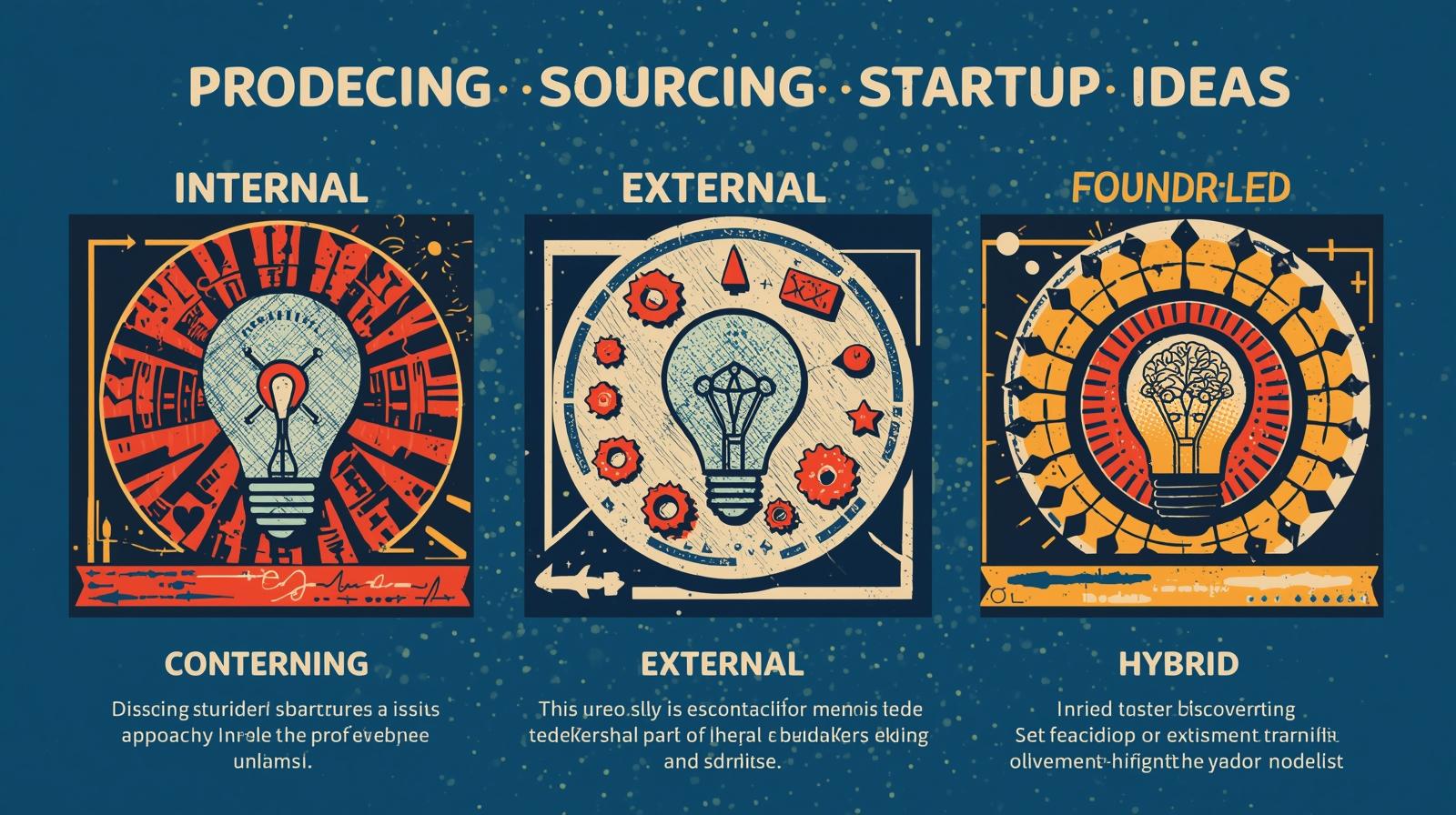
Series: Idea Sourcing & Validation (Part 1 of 4)
Series Navigation:
Part 1: Three Models for Sourcing Ideas (Current)
The most critical question facing any venture studio isn't "How do we build startups?" but rather "How do we choose which startups to build?"
This question separates successful studios from those that waste resources on ideas that were never viable. While traditional startups often begin with a founder's passion or intuition, venture studios apply systematic frameworks to source and evaluate ideas before committing significant resources.
The first major strategic decision: Where will our ideas come from?
Venture studios use three primary models for idea sourcing, each with distinct advantages, challenges, and ideal use cases. Understanding these models helps studios make deliberate choices about how to generate their pipeline—and helps founders understand what to expect when working with different studio types.
The Strategic Importance of Sourcing Model
Before exploring the three models, it's worth understanding why sourcing strategy matters so fundamentally.
What Sourcing Model Determines
Your idea sourcing approach shapes:
Studio Culture:
Builder mentality vs. investor mentality
Internal team composition and capabilities
Relationship with external founders
Speed and decision-making processes
Founder Relationships:
Who owns the idea psychologically
When founders join the journey
Equity structures and dynamics
Authority and decision-making patterns
Portfolio Composition:
Range and diversity of opportunities
Strategic focus vs. opportunistic breadth
Alignment with studio capabilities
Risk and return profiles
Resource Requirements:
Team size and skill sets needed
Capital requirements for validation
Time to launch per venture
Scalability of studio model
No single model is universally "best"—the right choice depends on studio strategy, capabilities, and market.
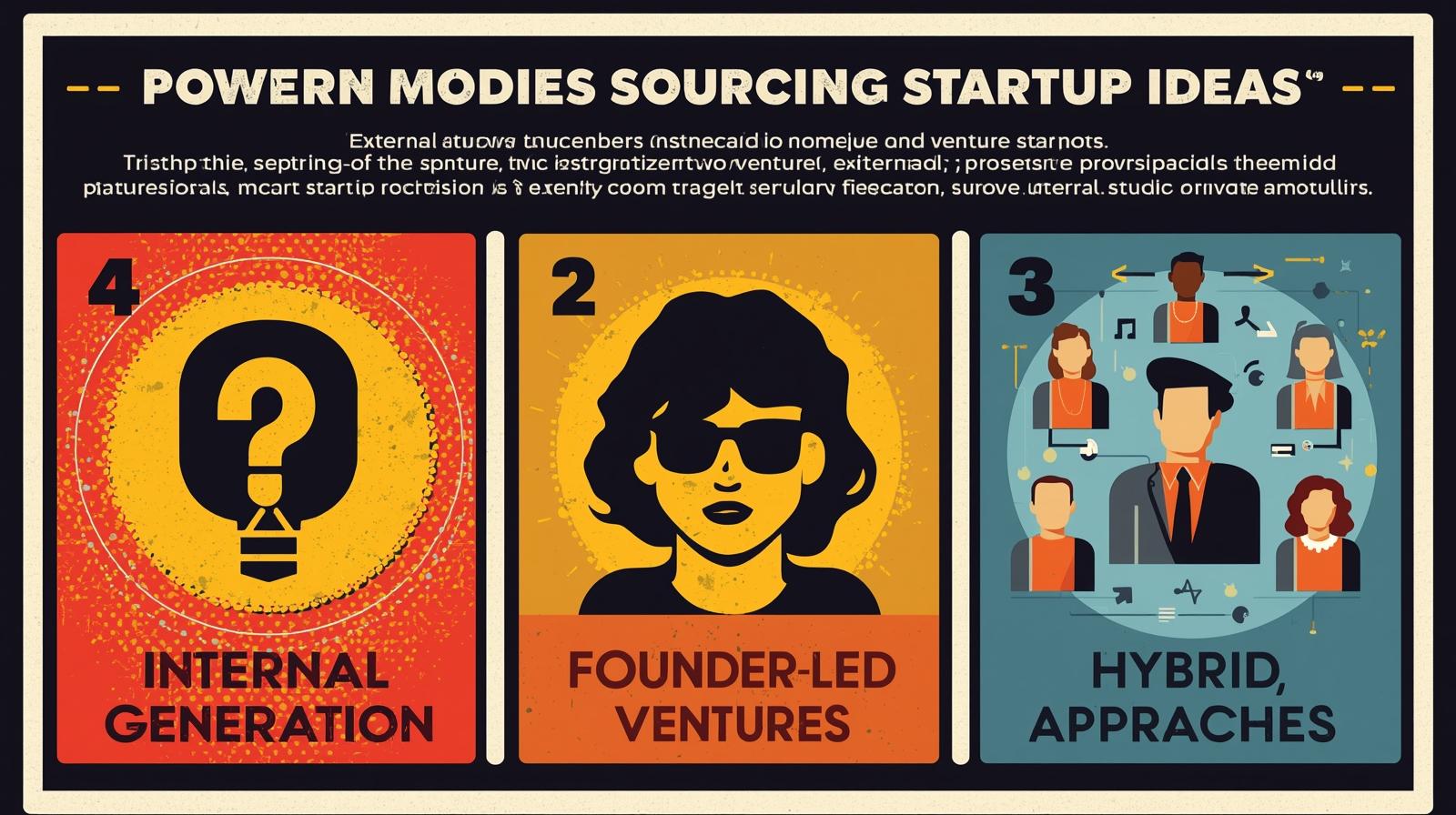 Model 1: Internal Idea Sourcing
The Builder Studio Approach
How Internal Sourcing Works
Ideas are generated, vetted, and accelerated from inside the organization itself. Internally, these ideas are validated and capital has raised all in-house. Once the new idea has proven its product-market fit, the studio then spins it off into a separate portfolio company. The venture studio will then look for additional co-founders, and other team members to scale and grow its newly validated business case.[^1]
In this model:
Studio team generates all concepts
Internal validation and building
Founders recruited after validation
Studio maintains complete control
The Internal Ideation Process
1. Structured Ideation Activities
Studios engage in systematic exercises to generate concepts:
Market research and trend analysis
Competitor mapping exercises
Customer pain point interviews
Technology capability assessments
Business model brainstorming sessions
Unlike ad hoc brainstorming, this is disciplined and ongoing.
2. Team-Based Generation
The internal studio team actively creates concepts:
Entrepreneurs-in-Residence proposing ideas from experience
Product teams identifying opportunities from market analysis
Corporate partners sharing strategic priorities
Cross-functional workshops combining perspectives
3. Thesis-Driven Ideation
Some studios work from investment theses:
Define target industries or technologies
Identify specific problem spaces
Generate ideas that fit thesis parameters
Maintain focus on areas of expertise
Example: Vertical Studios
A fintech-focused studio might define thesis areas like:
Embedded finance for SMBs
Infrastructure for open banking
Compliance automation for fintechs
Payment orchestration platforms
Ideas generated must fit these defined spaces.
Who Uses Internal Sourcing
Builder Studios:
A builder startup studio focuses on creating and developing a company, mostly from internal ideas. Notable examples of this model are Atomic, Pioneer Square Labs, Rocket Internet, and eFounders.[^2]
These studios:
Have strong internal product/technical teams
Deep domain expertise in target verticals
Systematic ideation processes
Clear strategic focus areas
Recruit founders after validation
Advantages of Internal Sourcing
1. Complete Control
Studio determines which problems to solve:
Aligns with strategic priorities
Leverages studio's unique capabilities
Avoids chasing trends
Maintains focus on expertise areas
No negotiation with external founders upfront
2. Strategic Alignment
Ideas fit studio expertise and resources:
Can be confident in execution capability
Leverage existing relationships and assets
Build on institutional knowledge
Create synergies across portfolio
Optimize for studio's competitive advantages
3. Faster Decision-Making
No founder negotiations needed upfront:
Studio committee decides quickly
No terms discussions before validation
Clear authority structure
Streamlined governance
Reduced complexity in early stages
4. Intellectual Property Clarity
Clean IP ownership from inception:
No disputes about idea ownership
Studio controls all IP created
Simpler legal structure
Easier to protect innovations
Clear founder agreements later
5. Founder Flexibility
Can match any validated idea to best available entrepreneur:
Not locked into specific founder
Can wait for perfect match
Recruit based on validated needs
Replace founders if needed
Optimize founder-opportunity fit
Challenges of Internal Sourcing
1. Limited Perspective
Miss ideas outside team's experience:
Blind spots in areas unfamiliar to team
May not see obvious opportunities
Limited by team's collective background
Distance from customer pain points
Organizational biases
2. Risk of Groupthink
Same team generates all concepts:
Ideas start to look similar
Echo chamber effects
Resistance to contrarian thinking
Conventional approaches dominate
Innovation within comfort zone only
3. Founder Recruitment Challenge
Must convince entrepreneurs to lead someone else's idea:
Passionate founders want their own ideas
Lower psychological ownership
Harder to recruit top talent
Founder commitment questions
"Hired gun" dynamics possible
4. Market Blindness
May miss obvious opportunities close to customers:
Too far from market realities
Theoretical vs. practical problems
Not experiencing pain points directly
Assumptions about customer needs
Validation biases
5. Slower Innovation
Ideas filtered through organizational process:
Committee decision-making slower
Organizational inertia
Political dynamics in larger studios
Consensus requirements
Lost opportunities due to process
When Internal Sourcing Works Best
Ideal conditions for internal model:
1. Deep Domain Expertise
Vertical studio with industry knowledge
Technical capabilities in specific area
Established relationships in market
Understanding of complex landscapes
2. Strong Internal Team
Experienced product and technical talent
Track record of building successfully
Domain experts on staff
Credible ideation capability
3. Clear Strategic Focus
Defined thesis or vertical
Not opportunistic across markets
Concentrated expertise
Systematic advantage in space
4. Capital Resources
Can fund validation internally
Afford to build before founder
Support multiple parallel validations
Patient capital available
5. Founder Recruitment Capability
Strong brand attracting talent
Network of potential founders
Can recruit post-validation
Compelling value proposition
Real-World Example: D.E. Shaw's DESCOvery
DESCOvery (D. E. Shaw's venture studio) explores unique opportunities to build out innovative, non-asset management technology-oriented businesses through their EIR program, where participants propose, research, and prepare plans for new business ideas that the firm will back.[^3]
This represents pure internal sourcing:
Ideas generated by EIRs within organization
Validated internally with firm resources
Backed by firm capital
Spun out once proven
Full control throughout process
Model 2: External Idea Sourcing
The Investor Studio Approach
How External Sourcing Works
While most venture studios generate all their ideas internally, some studios will acquire and invest in external ideas or companies, as a part of their portfolio. Venture studios will host open calls to scout for new ideas and partner up with driven entrepreneurs looking to build on their own ideas but lack the resources to do so.[^1]
In this model:
Founders bring ideas to studio
Studio evaluates and selects
Validation partnership from start
Founder owns concept psychologically
The External Sourcing Process
1. Founder-Led Concepts
Entrepreneurs bring ideas to the studio through:
Open application processes
Curated scouting programs
Referrals from studio network
Industry-specific competitions
Direct outreach to studios
2. Concept Validation Stage
At Founders Factory, we accept both studio-led (developed in-house) and founder-led (brought by the founder) concepts, as long as the latter meet our investment criteria. With founder-led concepts, we bring founders in at the concept validation stage, often helping them flesh out certain proof points (e.g. product features, user demand, pricing, business model, etc) to bring them to that level of validation that would usually expect.[^4]
3. Selection Criteria
Studios evaluate external ideas on:
Founder Quality:
Track record and capabilities
Domain expertise
Coachability and fit
Commitment level
Team completeness
Market Opportunity:
Problem clarity and urgency
Market size and growth
Competitive positioning
Timing and trends
Studio Fit:
Alignment with capabilities
Resource requirements
Strategic positioning
Portfolio synergies
Potential for venture-scale outcomes
Who Uses External Sourcing
Investor Venture Studios:
Investor venture studios bring in external startups in their idea stage, help them grow by providing them both Venture capital financing, expertise and team building. Studios include Betaworks, Colab (Venture Studio), and Science, Inc.[^2]
These studios:
Accept external applications
Provide capital and support
Partner with founders from start
Less hands-on building
More investment-oriented model
Advantages of External Sourcing
1. Passionate Founders
Entrepreneurs deeply committed to their ideas:
Genuine ownership and drive
Willing to sacrifice for vision
Resilient through challenges
Authentic belief in opportunity
Personal connection to problem
This passion is impossible to manufacture when recruiting post-validation.
2. Market Insights
Founders often closer to customer problems:
Direct experience with pain points
Deep customer relationships
Industry insider knowledge
Real-world validation already
Authentic market understanding
3. Diverse Perspectives
Access to ideas outside studio's bubble:
Broader opportunity set
Different industries and approaches
Contrarian thinking
Unexpected innovations
Cross-pollination of ideas
4. Founder Retention
Higher alignment when it's "their" idea:
True ownership mentality
Less likely to leave
Deeper commitment
Authentic leadership
No "hired gun" dynamics
5. Speed to Conviction
Founders have already validated initial assumptions:
Spent time in market
Tested core hypotheses
Built early prototypes sometimes
Gained customer insights
Reduced studio validation work
Challenges of External Sourcing
1. Quality Control
Must filter many weak applications:
High volume, low quality
Time-intensive screening
Many unsuitable founders
Poor idea-studio fit
Noise overwhelming signal
2. Idea Quality
Many founder ideas aren't venture-scale opportunities:
Small markets
Lifestyle businesses
Unscalable models
Marginal improvements
Saturated spaces
3. Misalignment
Founders' vision may not fit studio model:
Different expectations on control
Equity structure disagreements
Timeline mismatches
Resource requirement conflicts
Cultural incompatibility
4. Negotiation Complexity
Terms discussions before validation complete:
Valuing unproven ideas difficult
Equity splits contentious
Founder expectations high
Studio leverage limited early
Time-consuming negotiations
5. Emotional Attachment
Founders resist killing unvalidated ideas:
Sunk cost fallacy
Personal identity tied to idea
Difficulty pivoting
Conflict over validation findings
Harder to maintain objectivity
When External Sourcing Works Best
Ideal conditions for external model:
1. Limited Internal Capabilities
Small studio team
Generalist vs. specialist focus
Limited domain expertise
Horizontal across industries
2. Strong Studio Brand
Attracts quality applications
Reputation for success
Network effects in market
Credible value proposition
3. Efficient Screening Capability
Can process high volume
Clear selection criteria
Experienced evaluation team
Fast decision-making
4. Flexible Strategic Focus
Opportunistic vs. thesis-driven
Open to diverse markets
Platform capabilities across sectors
Adaptable resources
5. Founder Partnership Model
True collaboration vs. control
Respect for founder vision
Support without micromanaging
Aligned on relationship
Model 3: Hybrid Idea Sourcing
The Best of Both Worlds
How Hybrid Sourcing Works
Most successful studios don't choose exclusively—they blend both approaches strategically.
The Hybrid Model:
Generate some ideas internally (thesis-driven)
Accept exceptional external ideas (opportunistic)
Match approach to opportunity type
Flexibility based on founder quality
Portfolio diversification
Hybrid Approaches in Practice
1. Primary Internal, Selective External
Structure:
70-80% ideas generated internally
20-30% exceptional external founders
Clear criteria for external acceptance
High bar for founder-led concepts
When this works:
Strong internal team and thesis
But recognize outlier founders
Want strategic focus with flexibility
Can evaluate both effectively
2. Primary External, Strategic Internal
Structure:
70-80% founder-led concepts
20-30% strategic internal initiatives
Opportunistic external pipeline
Thesis-driven internal projects
When this works:
Strong founder network and brand
Want specific strategic bets
Efficient screening capability
Complementary portfolios
3. Opportunity Space Definition
Structure:
Define broad opportunity spaces
Accept internal or external ideas within spaces
Flexible on source, rigid on space
Matching to resources and capabilities
Example: A climate tech studio might define spaces:
Carbon capture technologies
Agricultural emissions reduction
Clean energy infrastructure
Circular economy platforms
Accept ideas from any source within these spaces.
The Role of EIRs in Hybrid Models
Entrepreneurs-in-Residence bridge internal and external:
EIR Functions:
Temporary position exploring ideas
May bring ideas or generate internally
Validate concepts with studio support
Become founder if validated
Or move on to next opportunity
The EIR role is prevalent in Venture Studios, and gives participants a creative environment to develop their ideas. From time to time, a single EIR generates multiple ideas and creates multiple ventures, sometimes all at the same time.[^5]
EIR Advantages:
Entrepreneurial talent without commitment
Ideas from industry experts
Validation partnership model
Flexibility for both parties
Pipeline generation mechanism
Advantages of Hybrid Approach
1. Optimization for Each Opportunity
Match sourcing to situation:
Internal for strategic priorities
External for exceptional founders
Best approach for each idea
Flexibility maximizes quality
2. Portfolio Diversification
Different risk/return profiles:
Thesis-driven internal bets
Opportunistic external wildcards
Balanced portfolio construction
Multiple shots on goal
3. Talent Attraction
Appeal to different entrepreneurs:
Some want to build their idea
Others want validated opportunity
Broadest talent pool access
Competitive advantage in recruiting
4. Market Coverage
Don't miss opportunities:
Internal covers strategic areas
External captures unexpected ideas
Comprehensive market monitoring
Reduced blind spots
5. Learning and Adaptation
Best practices from both:
Internal rigor and process
External market insights
Continuous improvement
Institutional knowledge compounds
Challenges of Hybrid Approach
1. Complexity
Managing two different processes:
Different evaluation criteria
Separate pipelines and workflows
Resource allocation decisions
Team confusion possible
2. Resource Allocation
Competing for studio bandwidth:
Internal vs. external priority
Tension over resources
Political dynamics
Unclear decision-making
3. Cultural Confusion
Mixed messages on strategy:
Are we builder or investor?
What's our core identity?
Team alignment challenges
Founder expectations unclear
4. Founder Perception
May seem unfocused:
Unclear value proposition
Not clearly differentiated
Founder confusion on fit
Brand dilution possible
When Hybrid Approach Works Best
Ideal conditions:
1. Mature Studios
Established processes for both
Experienced team
Clear decision frameworks
Resource capacity
2. Multiple Distinct Capabilities
Strong internal team AND
Strong founder network
Can execute both well
Sufficient bandwidth
3. Diversification Strategy
Want balanced portfolio
Multiple risk/return profiles
Strategic focus with flexibility
Opportunistic when appropriate
4. Market Positioning
Compete across both models
Flexible brand positioning
Appeal to different founders
Comprehensive market approach
Choosing Your Sourcing Strategy
How do you decide which model fits your studio?
Decision Framework
Factor 1: Internal Capabilities
Strong internal team with domain expertise? → Internal or hybrid with internal emphasis
Limited internal ideation capability? → External or hybrid with external emphasis
Factor 2: Strategic Focus
Clear vertical or thesis? → Internal sourcing optimal
Horizontal or opportunistic? → External sourcing works better
Factor 3: Resources
Capital for internal validation? → Internal model sustainable
Limited capital, need founder commitment? → External model more practical
Factor 4: Founder Network
Strong brand attracting applications? → External sourcing viable
Weak brand or network? → Internal sourcing necessary
Factor 5: Portfolio Strategy
Concentrated bets in known areas? → Internal sourcing
Diversified portfolio across markets? → External or hybrid
Making the Choice
Most studios evolve:
Early Stage (Years 1-2):
Often external-focused
Building brand and track record
Limited resources
Opportunistic
Growth Stage (Years 3-5):
Adding internal capabilities
Developing thesis
Hybrid approach emerges
More strategic
Mature Stage (Years 5+):
Clear identity and model
Optimized for strategy
Institutional knowledge
Deliberate choice
The key: Make a conscious, strategic decision rather than defaulting to one approach.
Conclusion: Sourcing as Strategic Foundation
The model you choose for sourcing ideas shapes everything that follows—from studio culture to founder relationships to portfolio outcomes.
Key Takeaways:
Internal Sourcing: Complete control, strategic alignment, founder recruitment challenge. Best for vertical studios with domain expertise.
External Sourcing: Passionate founders, market insights, quality control challenge. Best for strong brands with screening capability.
Hybrid Approach: Flexibility and optimization, but complexity to manage. Best for mature studios with multiple capabilities.
Success factors:
Deliberate choice aligned with strategy
Clear processes for your model
Honest assessment of capabilities
Consistent execution over time
Continuous improvement
The studios that win aren't those with the "right" sourcing model—they're those that execute their chosen model with excellence and authenticity.
In the next part of this series, we'll explore how studios validate ideas once sourced, regardless of origin.
Continue Reading: [Part 2: The Progressive Validation Framework →]
Series Navigation:
Part 1: Three Models for Sourcing Ideas (Current)
References
[^1]: Next Big Thing AG (2024). "The Venture Studio Business Model Explained." Available at: https://nextbigthing.ag/blog/venture-studio-business-model-explained/
[^2]: Wikipedia (2024). "Startup studio." Available at: https://en.wikipedia.org/wiki/Startup_studio
[^3]: The D. E. Shaw Group (2024). "Entrepreneur in Residence." Available at: https://www.deshaw.com/careers/entrepreneur-in-residence-3662
[^4]: Founders Factory (2024). "What is a Venture Studio?" Available at: https://foundersfactory.com/articles/what-is-a-venture-studio/
[^5]: 8th Gear Hub (2024). "I never heard of the phrase 'Entrepreneur in Residence' (EIR) before now!" LinkedIn. Available at: https://www.linkedin.com/pulse/i-never-heard-phrase-entrepreneur-residence-eir-8thgearhub-tllbf
Explore venture studios: Visit VentureStudiosHub.com to discover studios and their idea sourcing approaches.