
Series: Building Founding Teams (Part 4 of 5)

A solo founder with a validated opportunity is a good start. A complete founding team with complementary skills, aligned values, and strong chemistry is transformational.
Most successful startups have founding teams, not solo founders.
According to research, startups with co-founder teams raise more capital, exit more successfully, and survive longer than solo-founder ventures. Yet finding the right co-founder is notoriously difficult—it's often compared to finding a spouse for the business.
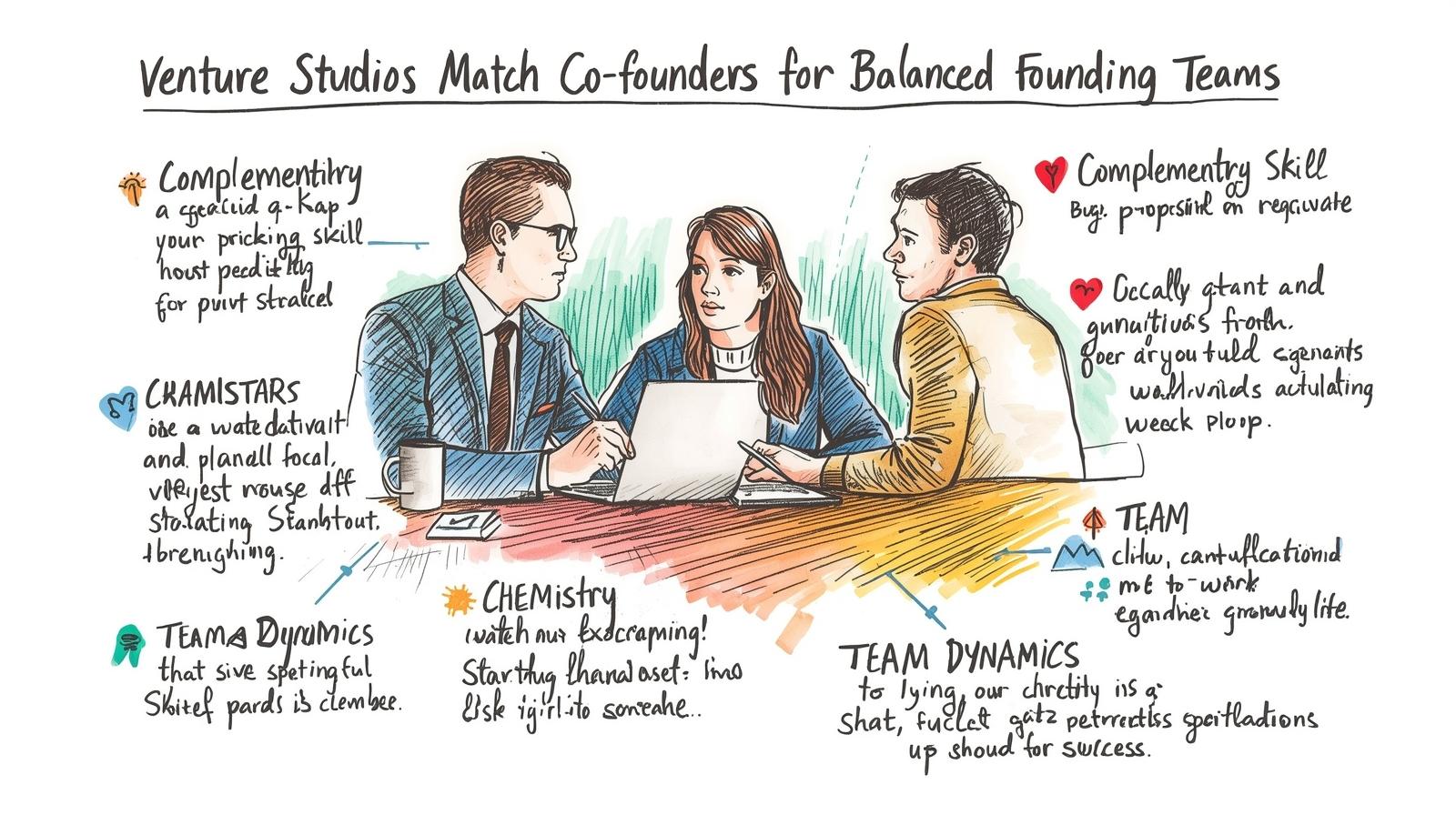
Venture studios have a unique advantage: they can systematically match co-founders rather than leaving it to chance. Instead of entrepreneurs searching blindly for complementary partners, studios can architect founding teams based on opportunity requirements and proven compatibility principles.
This capability—thoughtfully constructing balanced founding teams—represents one of the most powerful but underutilized advantages of the studio model.
Why Co-Founder Teams Outperform Solo Founders
Before exploring how to match co-founders, it's worth understanding why teams matter.
The Advantages of Co-Founder Teams
1. Complementary Skills
No single person has all necessary capabilities:
Technical depth + commercial acumen
Product vision + operational excellence
Industry expertise + startup experience
Introversion + extroversion
Strategic thinking + tactical execution
Founding teams can cover more ground.
2. Emotional Support
Building startups is emotionally grueling:
Having someone who understands
Shared burden of decisions
Someone to process challenges with
Mutual encouragement through setbacks
Not facing the loneliness alone
Co-founders provide psychological resilience.
3. Better Decision-Making
Two perspectives beat one:
Challenges assumptions
Reduces blind spots
Balances biases
Debates improve outcomes
Sanity checks prevent mistakes
But only if they can disagree productively.
4. Increased Credibility
Teams signal seriousness:
Investors prefer teams
Customers take teams more seriously
Recruits more confident joining teams
Partners view teams as more stable
Team demonstrates commitment
5. Bandwidth and Capacity
Simply more hands on deck:
Can tackle parallel workstreams
Cover more customer conversations
One founder can handle ops while other sells
Never single point of failure
Faster execution possible
6. Skill Development
Co-founders teach each other:
Knowledge transfer across domains
Learning accelerated through partnership
Each becomes more complete through collaboration
Mentorship flows both directions
Growth through complementary expertise
The Risks of Poor Co-Founder Matches
The flip side: bad co-founder relationships destroy companies.
Common co-founder problems:
Misaligned vision or values
Conflict over decision-making authority
Unequal work ethic or commitment
Communication breakdowns
Inability to resolve disagreements
Personal compatibility issues
Co-founder conflict is a leading cause of startup failure.
Research suggests 65% of startups fail due to co-founder conflict. The wrong match is worse than no co-founder at all.
This is where studios add tremendous value—systematically matching compatible co-founders rather than leaving it to chance.
The Complementary Skills Framework
The foundation of good co-founder matching: complementary capabilities that create a complete founding team.
The Classic Split: Technical + Commercial
The most common complementary pairing:
Technical Co-Founder (CTO):
Builds the product
Leads engineering team
Makes architectural decisions
Handles technical debt
Stays current with technology
Commercial Co-Founder (CEO):
Defines product strategy
Leads go-to-market
Manages fundraising
Handles sales and partnerships
Builds commercial team
Why it works:
Clear division of responsibilities
Minimal overlap or conflict
Both roles mission-critical
Mutual respect for different expertise
Proven pattern across thousands of companies
When it works best:
Technical products requiring deep expertise
B2B SaaS and enterprise software
Hardware and deep tech
Platform businesses
Infrastructure companies
Beyond Tech + Commercial: Other Powerful Combinations
Industry Expert + Startup Operator
Industry Expert:
Deep domain knowledge
Customer relationships
Regulatory understanding
Competitive intelligence
Credibility with buyers
Startup Operator:
Speed and execution
Lean startup methodology
Fundraising experience
Team building
Growth tactics
Why it works:
Domain credibility + execution speed
Industry insight + startup agility
Established relationships + operational excellence
When it works best:
Regulated industries (healthcare, fintech)
Complex B2B markets
Industries resistant to outsiders
Vertical-specific opportunities
Product Visionary + Growth Expert
Product Visionary:
User experience obsession
Product strategy and roadmap
Design sensibility
Feature prioritization
Product-market fit iteration
Growth Expert:
Customer acquisition mastery
Data-driven optimization
Channel expertise
Conversion optimization
Scaling playbooks
Why it works:
Great product + ability to grow it
Vision + execution on distribution
Build the right thing + get it to customers
When it works best:
Consumer products
Product-led growth businesses
Marketplaces
Network effect businesses
Hustler + Analyst
Hustler:
Sales and BD focus
Relationship builder
Charismatic communicator
Closes deals
Generates momentum
Analyst:
Data-driven decisions
Financial modeling
Operations optimization
Process and systems
Strategic planning
Why it works:
Energy + discipline
Momentum + sustainability
Intuition + analysis
Speed + deliberation
When it works best:
Early-stage customer acquisition
Businesses requiring aggressive BD
Complex operational models
Capital-intensive businesses
The Three-Founder Model
Some opportunities require three co-founders:
Classic Trinity: CEO + CTO + CPO
CEO (Commercial):
Strategy and vision
Fundraising
Sales and partnerships
Team building
External stakeholder management
CTO (Technical):
Engineering leadership
Technical architecture
Infrastructure and scale
Engineering team building
Technical debt management
CPO (Product):
Product strategy
User experience
Feature prioritization
Customer insights
Product-market fit
Why it works:
Three critical functions separated
Clear ownership domains
Balanced leadership
No single founder overwhelmed
When it works best:
Complex technical products
Consumer products requiring design excellence
B2B SaaS at scale
Platform businesses
Challenges:
More complex decision-making
Equity split across three
Higher communication overhead
Potential for 2-vs-1 dynamics
Harder to align three people
Studios should be cautious with three-founder teams—two is usually optimal.
The Critical Co-Founder Dynamics
Skills complement each other. But do the people?
Essential Dynamic #1: Mutual Respect
Foundation of all successful co-founder relationships.
Each founder must genuinely respect:
The other's expertise and capabilities
Their judgment and decision-making
Their work ethic and commitment
Their contribution to the venture
Their fundamental competence
Without mutual respect:
One founder second-guesses the other constantly
Decisions get relitigated
Authority gets undermined
Team members confused about leadership
Partnership becomes dysfunctional
How studios evaluate mutual respect:
Do they speak admiringly about each other?
Do they defer to each other's expertise?
Do they give credit generously?
Do they trust each other's decisions?
Is there any condescension or dismissiveness?
Essential Dynamic #2: Aligned Values
Co-founders must agree on fundamental principles:
Core values alignment:
Work ethic and intensity
Integrity and ethics
Customer treatment
Team culture priorities
Risk tolerance
Growth vs. profitability philosophy
Work-life balance expectations
Misaligned values create constant friction:
One founder wants to grow fast, other wants sustainability
One okay cutting corners, other demands integrity
One expects 80-hour weeks, other wants balance
One treats employees as resources, other as partners
One makes aggressive bets, other risk-averse
These differences are rarely resolvable—they reflect deep-seated beliefs.
How studios evaluate values alignment:
Discuss hypothetical ethical dilemmas
Explore past difficult decisions
Probe work-life philosophy
Understand risk tolerance
Examine growth philosophy
Ask about team culture vision
Essential Dynamic #3: Clear Communication
The ability to communicate effectively, especially during conflict.
Strong co-founder pairs:
Share information proactively
Express concerns directly
Listen actively and empathetically
Disagree without personal attacks
Resolve conflicts constructively
Give feedback compassionately
Poor communication patterns:
Passive-aggressive behavior
Withholding information
Avoiding difficult conversations
Personal attacks during disagreement
Inability to compromise
Talking past each other
Communication gaps compound over time—small issues become relationship-destroying resentments.
How studios evaluate communication:
Watch them discuss difficult topics
Observe how they handle disagreement
See how they give each other feedback
Notice listening behaviors
Assess willingness to be vulnerable
Evaluate conflict resolution attempts
Essential Dynamic #4: Complementary Working Styles
How people work matters as much as what they do.
Key working style dimensions:
Pace:
Fast-moving vs. deliberate
Bias to action vs. analysis before action
Iteration speed vs. perfection focus
Decision-making:
Intuitive vs. data-driven
Decisive vs. collaborative
Risk-taking vs. risk-averse
Communication:
High-context vs. explicit
Frequent check-ins vs. autonomous
Verbal vs. written preference
Organization:
Structured vs. flexible
Process-oriented vs. adaptive
Planning vs. improvising
Ideal: Complementary but not opposing.
Examples of good complementarity:
One moves fast, one catches mistakes (productive)
One intuitive, one analytical (balanced decisions)
One big picture, one detail-oriented (comprehensive)
Examples of destructive opposition:
One needs constant communication, other wants independence (frustration)
One makes quick decisions, other endlessly analyzes (paralysis)
One chaotic, other rigid (constant conflict)
Essential Dynamic #5: Trust
The belief that your co-founder has your back.
Trust means:
Confidence they'll do what they commit to
Belief they act in company's best interest
Assurance they won't undermine you
Faith they'll be honest even when hard
Certainty they're equally committed
Trust takes time to build but can shatter instantly.
Trust destroyers:
Broken commitments
Hidden agendas
Dishonesty or deception
Unequal effort
Undermining behind back
Disloyalty during conflicts
How studios build trust:
Start with smaller collaborations
Observe reliability over time
Test with progressively harder challenges
Watch response to pressure
See how they handle disagreements
Evaluate integrity in small moments
The Studio Co-Founder Matching Process
How do studios actually match co-founders?
Approach 1: Serial Recruitment (Find CEO First, Then Co-Founder)
Most common studio approach:
Step 1: Studio validates opportunity
Step 2: Recruit founding CEO
Typically focuses on commercial/strategy
Or industry expert if vertical opportunity
Or product visionary if product-led
Step 3: Define complementary co-founder needs
Based on CEO's strengths/gaps
Opportunity requirements
Stage-appropriate capabilities
Step 4: Recruit complementary co-founder
CEO often involved in search
Studio provides candidates/network
Mutual evaluation period
Chemistry assessment critical
Advantages:
CEO owns team composition
Natural chemistry testing
CEO commitment before co-founder search
Clear skill gaps to fill
Challenges:
Takes longer (serial process)
CEO may struggle finding right match
Pressure to compromise on fit
Second founder may feel secondary
Approach 2: Parallel Recruitment (Match Pairs Simultaneously)
Alternative approach some studios use:
Step 1: Studio validates opportunity
Step 2: Define ideal founding team profile
Required skill combinations
Complementary capabilities needed
Team composition designed
Step 3: Recruit multiple candidates simultaneously
Source for different role profiles
Evaluate individually
Assess team combinations
Step 4: Match complementary pairs
Studio facilitates introductions
Structured evaluation process
Chemistry testing
Mutual selection
Advantages:
Faster to complete team
Studio can architect optimal combinations
Co-founders enter as true equals
Can test multiple combinations
Challenges:
Complex process to manage
Both founders may feel studio-imposed
Less organic chemistry development
Requires strong studio matching capability
Approach 3: Pre-Matched Teams (Recruit Teams Together)
Some studios recruit existing pairs:
Step 1: Studio validates opportunity
Step 2: Seek pre-existing founder pairs
Recruiting teams, not individuals
Prior working relationships
Proven compatibility
Complementary skills already
Step 3: Match team to opportunity
Evaluate collective fit
Assess skill match to needs
Test alignment with opportunity
Advantages:
Relationship already validated
Chemistry already proven
Team dynamics established
Faster to launch
Challenges:
Fewer available pre-matched teams
May not perfectly match opportunity
Harder to find in market
Less studio control over composition
Studio's Role in Co-Founder Matching
Regardless of approach, studios provide:
Network Access:
Introductions to potential co-founders
Leverage studio relationships
Create matching opportunities
Access to EIRs and studio team
Candidate Evaluation:
Skills assessment
Reference checking
Values alignment testing
Working style evaluation
Prior relationship investigation
Structured Chemistry Testing:
Facilitated working sessions
Joint problem-solving exercises
Decision-making simulations
Conflict scenario discussions
Values and philosophy exploration
Negotiation Support:
Equity split guidance
Role definition clarity
Decision-making framework
Founder agreement templates
Conflict resolution mechanisms
Ongoing Mediation:
Early conflict resolution
Communication coaching
Relationship check-ins
Third-party perspective
Partnership strengthening
Evaluating Co-Founder Chemistry
How do studios assess whether two founders will work well together?
Structured Evaluation Methods
1. Joint Working Sessions
Put founders in room to solve problems:
Present real company challenge
Watch how they collaborate
Observe decision-making process
See communication patterns
Note conflict navigation
What to watch for:
Do they build on each other's ideas?
How do they handle disagreement?
Who dominates conversation?
Do they listen actively?
Can they reach decisions?
2. Values and Philosophy Discussions
Explore fundamental beliefs:
Hypothetical ethical dilemmas
Growth vs. profitability philosophy
Team culture priorities
Work-life balance views
Risk tolerance scenarios
Customer treatment principles
What to watch for:
Where do they align?
Where do they differ?
How do they handle differences?
Are gaps bridgeable?
Any dealbreakers?
3. Reference Checks on Relationship
If founders have prior relationship:
Talk to people who've seen them together
Understand their working dynamic
Learn about past conflicts
Discover how they resolved issues
Assess relationship trajectory
What to ask:
How do they work together?
How do they handle disagreement?
How is decision-making shared?
Any concerning patterns?
Would you work with this team?
4. Simulated Conflicts
Present difficult scenarios:
Major strategic decision disagreement
Resource allocation conflicts
Handling underperforming team member
Pivot or persist dilemma
Founder role adjustment needed
What to watch for:
Conflict avoidance or engagement?
Respect during disagreement?
Ability to find compromise?
Recovery after heated moment?
Patterns of resolution?
5. Individual Interviews About Partnership
Separately ask each founder:
What excites you about this partnership?
What concerns you?
How will you handle disagreements?
What's non-negotiable for you?
How do you see roles dividing?
What to watch for:
Alignment in expectations
Realistic about challenges
Genuine enthusiasm
Any red flags or reservations
Thoughtfulness about partnership
Red Flags in Co-Founder Matching
Warning signs of problematic pairing:
Immediate Concerns:
Lack of mutual respect
One founder dominates completely
Fundamental values misalignment
Poor communication patterns
Prior relationship baggage
Unequal commitment levels
Situational Concerns:
Overly similar skillsets (not complementary)
Competing for same role
Unclear decision-making authority
Different risk tolerances
Misaligned incentives
Friends/family without business relationship
Behavioral Concerns:
Passive-aggressiveness
Inability to disagree directly
Personal attacks during conflict
Unwillingness to compromise
Keeping score or tallying contributions
Lack of trust signals
When red flags appear: Pause. Most issues don't improve under pressure—they intensify.
Green Flags in Co-Founder Matching
Positive indicators of strong partnership:
Relationship Quality:
Genuine enjoyment of working together
Easy communication and rapport
Mutual respect evident
Shared sense of humor
Comfortable with vulnerability
Complementarity:
Clear skill differentiation
Natural role division emerging
Respect for different expertise
Building on each other's strengths
Filling each other's gaps
Alignment:
Shared vision and values
Similar work ethic
Compatible working styles
Aligned incentives
Common understanding of success
Conflict Management:
Healthy disagreement patterns
Direct communication
Quick conflict resolution
Ability to move forward
Learning from differences
Commitment:
Equal dedication level
Long-term orientation
Both "all in" mentality
Shared sacrifice willingness
Partnership priority
Founder Agreements: Documenting the Partnership
Once co-founders are matched, document the partnership.
Essential Founder Agreement Elements
1. Equity Split
How ownership is divided:
Initial allocation (often 50/50 for equal pairs)
Vesting schedule (typically 4 years, 1-year cliff)
Acceleration provisions
Adjustment mechanisms
Vesting is critical: Ensures both founders remain committed. If one leaves early, unvested shares return to company.
2. Roles and Responsibilities
Who does what:
Title and primary domain
Decision-making authority
Key responsibilities
Reporting structures if team grows
Clarity prevents conflict: When roles overlap or gaps exist, friction emerges.
3. Decision-Making Framework
How decisions get made:
Who has final say on what
What requires consensus
Tiebreaker mechanisms
Major decisions requiring agreement
Example framework:
Product decisions: Product co-founder
Engineering: Technical co-founder
Major pivots: Consensus required
Fundraising: Commercial co-founder with input
Hiring executives: Consensus required
4. Conflict Resolution Process
How disagreements get resolved:
Direct conversation first
Mediation by studio if needed
Outside advisors/board if necessary
Escalation process defined
Having process before conflict is critical.
5. Exit Mechanisms
What happens if partnership fails:
Voluntary departure terms
Termination conditions
Buyout provisions
Non-compete agreements
IP and customer protections
Uncomfortable to discuss, essential to document.
Equity Split Philosophy
Common approaches to splitting founder equity:
Equal Split (50/50 for two founders):
Arguments for:
Signals equal partnership
Avoids early hierarchy
Recognizes both are essential
Motivates both equally
Standard convention
Arguments against:
May not reflect actual contribution
One founder might do more
Different experience levels
Joining at different times
Studio did validation (not equal zero)
Differentiated Split (60/40, 65/35, etc.):
When appropriate:
One founder brings idea/IP
Significant experience gap
Different joining times
Unequal initial contribution
Studio relationship differences
Challenges:
Can create resentment
Junior partner less motivated
Difficult to determine "fair" split
Contributions evolve over time
May not predict future value
Most common: Start equal (50/50), adjust only if strong reason exists.
Dynamic Equity Models:
Some agreements use formulas that adjust equity based on:
Hours contributed
Capital invested
Milestones achieved
Role evolution
Benefits: Reflects actual contribution
Challenges: Complex, requires tracking, can create gaming, focuses on wrong metrics
Generally not recommended for studio-backed ventures—adds complexity without benefit.
Building Beyond the Core: Adding to Founding Team
Once core co-founders are in place, when and how to add?
When to Add Third Founder
Consider adding third co-founder if:
Clear third critical function needed
Gap in founding pair skillset
Opportunity complexity demands it
Key relationship/expertise requires equity
Market timing demands speed
Don't add third founder if:
Could hire employee instead
Just want more hands
Diluting core team unnecessarily
Chemistry already complex
Decision-making would suffer
Early Employees vs. Founders
Key distinction:
Founders:
Substantial equity (10%+ typically)
Co-equal decision-making
"Founder" title
Before/at incorporation
High risk, high reward
Early Employees:
Smaller equity (0.5-2% typical)
Execute defined roles
Manager/director titles
After incorporation
Lower risk, regular salary
Studios should be disciplined: Don't give founder equity/title unless truly founder-level contribution.
The Studio's Diminishing Role
As founding team solidifies:
Founders own more decisions
Studio provides less day-to-day input
Team becomes increasingly independent
Studio shifts to board-level involvement
Founders become true CEOs/CTOs
Goal: Studio becomes helpful board member, not operating partner.
Conclusion: The Art and Science of Co-Founder Matching
Building balanced founding teams represents one of venture studios' most valuable—and underutilized—capabilities.
Key Takeaways:
Complementary Skills: Match technical with commercial, industry expert with operator, product with growth, based on opportunity needs.
Critical Dynamics: Mutual respect, aligned values, clear communication, complementary working styles, and trust determine success.
Matching Process: Studios can recruit serially, in parallel, or seek pre-matched teams. Each approach has tradeoffs.
Chemistry Evaluation: Structured working sessions, values discussions, conflict simulations, and reference checks assess compatibility.
Documentation: Founder agreements covering equity, roles, decision-making, conflict resolution, and exits protect partnerships.
Studios' advantage:
Systematic matching vs. chance
Network access for candidates
Structured evaluation capability
Conflict mediation support
Institutional knowledge of what works
The outcome: Well-matched founding teams that complement each other's skills, share values, communicate effectively, and trust each other enough to navigate the inevitable challenges of building startups.
Poor matches doom ventures. Great matches create partnerships that unlock extraordinary outcomes.
In the final part of this series, we'll explore the common mistakes studios make in assembling founding teams—and how to avoid them.
Continue Reading: [Part 5: Common Founding Team Mistakes →]
Series Navigation:
Part 4: Co-Founder Matching (Current)
Part 5: Common Founding Team Mistakes
References
Note: This article synthesizes established best practices in co-founder matching from venture studio practitioners, startup research, and organizational psychology literature. Specific sourcing on co-founder dynamics draws from academic research on founding team composition and venture studio operational frameworks.
Explore venture studios: Visit VentureStudiosHub.com to discover studios and their team-building approaches.