
Series: Building Founding Teams (Part 2 of 5)
Once you've decided when to recruit founders, the next critical question emerges: Where do you find them?
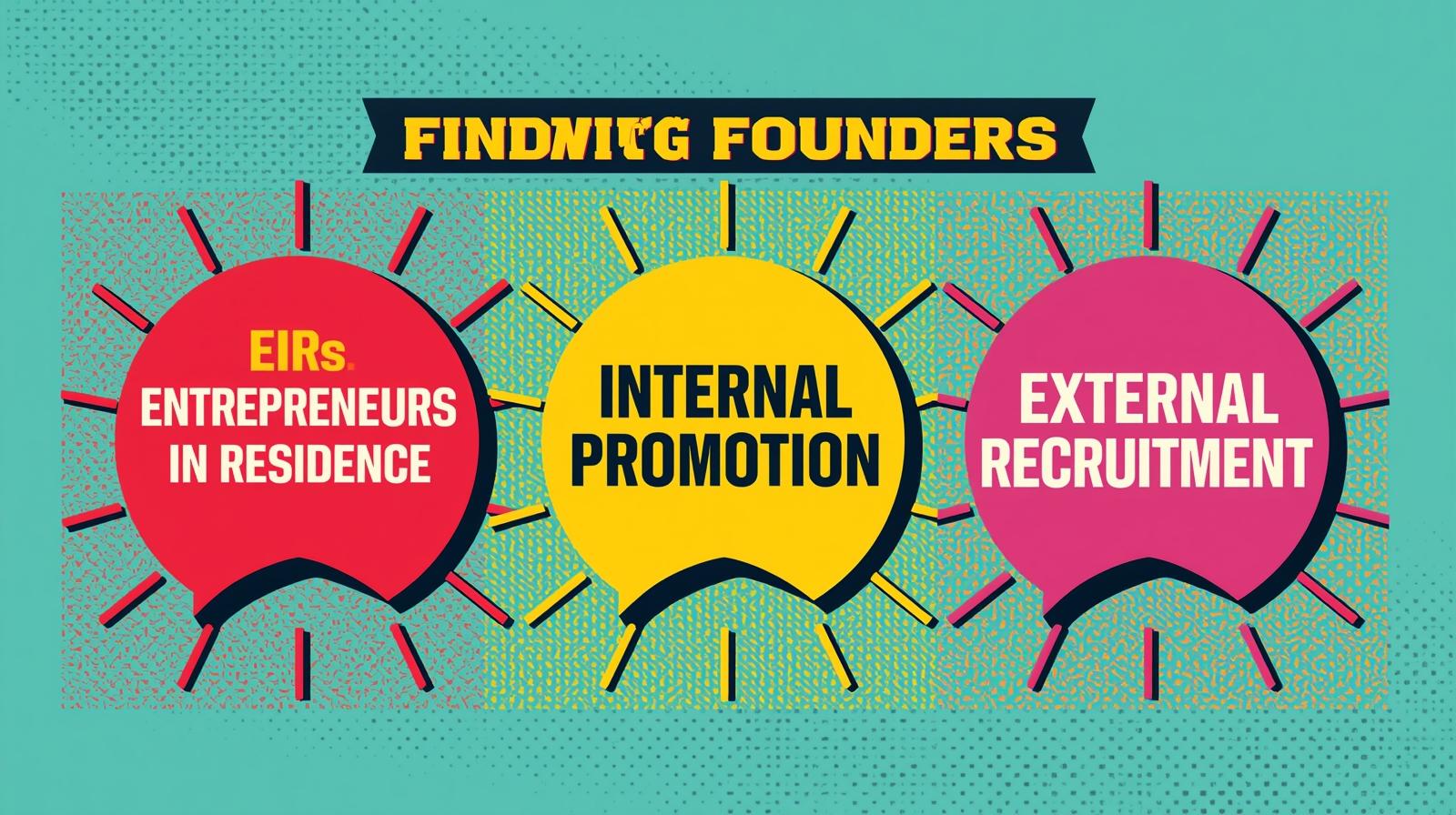
Venture studios use three primary sourcing paths, each with distinct advantages and challenges. The path you choose shapes not just who becomes a founder, but the entire dynamic between studio and venture.
Some studios cultivate entrepreneurs through formal Entrepreneur in Residence (EIR) programs. Others promote talented team members from within their studio operations. And many actively recruit externally, competing in the open market for entrepreneurial talent.
The most successful studios don't rely on a single path—they build multiple channels for founder acquisition.
Understanding these three sourcing strategies gives you options for building a robust founder pipeline that matches your studio model and timing approach.
Path 1: Entrepreneurs in Residence (EIRs)
The Entrepreneur in Residence model represents one of the most powerful founder sourcing mechanisms for venture studios.
What Is an EIR?
An EIR is someone brought in on a temporary basis, with a specific goal: finding an opportunity to validate, and if validated, to pursue.[^1]
Key characteristics:
Temporary position (typically 6-12 months)
Compensated during exploration period
Expected to generate and validate ideas
May become founder of validated opportunity
Or may leave to pursue other ventures
The relationship has a built-in timeline and mutual evaluation period.
The EIR Value Proposition
For the entrepreneur:
Salary/compensation during validation
Studio resources for market research
Access to studio network and expertise
Reduced personal financial risk
Option to become founder of validated idea
Flexibility to pass if opportunity isn't right
For the studio:
Pipeline of entrepreneurial talent
Committed resources for validation work
Deep evaluation of potential founders
Shared risk during exploration
Flexibility if EIR isn't right fit
Multiple bites at the apple with good EIRs
Types of EIR Arrangements
1. Idea-Free EIR
The studio recruits an entrepreneur without a specific idea:
EIR explores multiple opportunity areas
Works with studio on ideation
Validates studio-generated concepts
May pivot across different markets
Becomes founder of what validates
Best for: Studios with strong ideation capabilities and vertical expertise
2. Founder-with-Idea EIR
The entrepreneur brings a concept they want to validate:
Specific market hypothesis to test
EIR validates their own idea
Studio provides resources and guidance
Becomes founder if validated
May pivot to studio idea if original fails
Best for: Studios open to founder-led ideas and external market insights
3. Thesis-Driven EIR
Studio identifies opportunity space, recruits EIR to explore it:
Specific industry or problem area defined
EIR validates within boundaries
Solution approach emerges from validation
Founder-market fit develops through exploration
Becomes founder of opportunity in thesis area
Best for: Vertical studios with market hypotheses needing entrepreneurial validation
EIR Compensation Structures
How studios compensate EIRs during the exploration period:
Salary-Based:
Monthly stipend or salary
Typically $8K-15K per month
Health benefits sometimes included
Clear commitment period (6-12 months)
No equity during EIR phase
Advantages: Clear expectations, attracts experienced entrepreneurs, professional arrangement
Challenges: Expensive for studio, only sustainable with capital
Equity Options:
Lower or no salary
Options in future venture if founded
Sometimes studio equity
Potential founder equity stake
Advantages: Lower studio burn, aligns incentives long-term
Challenges: Less attractive to experienced entrepreneurs, unclear value
Hybrid Models:
Reduced salary plus equity potential
Performance bonuses tied to milestones
Transition to founder equity upon incorporation
Studio equity as bonus for successful validation
Most common approach for well-resourced studios.
The EIR Process: Month by Month
Months 0-1: Immersion and Research
Market research and landscape analysis
Customer discovery interviews
Competitive intelligence gathering
Problem hypothesis development
Studio network leveraging
Months 2-4: Validation Testing
Hypothesis testing with customers
Solution concept exploration
Business model investigation
Technical feasibility assessment
Market size validation
Months 4-6: Decision Point Preparation
Synthesis of findings
Go/no-go recommendation development
Business plan creation if validated
Pitch to studio investment committee
Pivot exploration if needed
Month 6+: Incorporation or Transition
If validated: Become founder, negotiate equity
If not validated: Part ways or try new idea
Handoff of insights to studio
Continued relationship or clean break
When EIR Model Works Best
Strong indicators for EIR approach:
Studio has validation expertise to transfer to EIRs
Vertical focus benefits from thesis-driven exploration
Capital available to compensate during exploration
Patient timeline acceptable for founder recruitment
Need for founder-market fit development through immersion
Advantages of the EIR Path
1. Built-in Evaluation Period
Both parties assess fit before commitment:
Studio evaluates entrepreneur's capabilities
EIR experiences studio culture and support
Working relationship tested before high-stakes
Communication and collaboration styles aligned
Red flags surfaced early
This mutual evaluation reduces founder-studio mismatches.
2. Founder Develops Deep Market Knowledge
Through months of validation work:
Becomes genuine expert in opportunity
Builds customer relationships organically
Understands competitive nuances
Develops authentic passion for problem
Earns founder-market fit through immersion
3. Shared Risk During Validation
Neither party over-commits initially:
Studio pays for validation without full founder commitment
EIR explores without career risk
Exit path exists if not validated
Pivot possible without burning relationship
Learning valuable even if this opportunity fails
4. Optionality for Both Parties
Flexibility built into arrangement:
EIR can decline to be founder if not passionate
Studio can choose not to incorporate if not convinced
Can try multiple ideas during EIR period
Relationship can continue on new concept
Clean exit path available
5. Pipeline Generation
EIR programs create ongoing founder flow:
Always have entrepreneurs in pipeline
Reduces urgency around any single founder
Multiple opportunities being explored simultaneously
Network effects from EIR alumni
Reputation built through successful placements
Challenges of the EIR Path
1. Expensive for Studios
EIR compensation adds up quickly:
$8-15K per month typical
6-12 month commitments
Multiple EIRs needed for portfolio approach
Only successful with adequate capital
Difficult for early-stage studios
2. No Guarantee of Success
Significant investment with uncertain outcome:
EIR may not validate any opportunity
Might not be right founder even if validated
Could leave for other opportunities
Validation work may not lead to incorporation
Studio investment could be unproductive
3. Requires Strong Studio Validation Capability
Studio must provide real value:
Need frameworks and methodologies
Industry expertise essential
Network access valuable
Operational support necessary
Without value-add, EIRs won't succeed
4. Founder Commitment Questions
Late-stage commitment can be problematic:
EIR may not feel full ownership
Can walk away more easily than traditional founder
"Hired gun" mentality possible
Less skin in the game during validation
Commitment tested only after incorporation
5. Cultural Fit Uncertainty
EIR arrangement is temporary:
True cultural compatibility emerges under stress
Honeymoon period during EIR phase
Real challenges come after incorporation
Founder independence needs may conflict with studio support
Partnership dynamics evolve post-EIR
 Path 2: Internal Promotion
Some studios find their best founders already work for them.
The Internal Founder Model
Promoting from within means taking someone already on your studio team and transitioning them into a founder role for one of your ventures.
This path leverages existing relationships and proven performance:
Studio team member demonstrates entrepreneurial capability
Shows deep interest in specific opportunity
Already understands studio methodology
Has worked on validation or building
Transitions from employee to founder
Types of Internal Transitions
1. Validation Team to Founder
Studio team member who validated opportunity becomes founder:
Led the validation work
Developed deep market knowledge
Built customer relationships
Already owns the insights
Natural transition to founder role
Most organic internal promotion path.
2. Product/Technical Lead to Founder
Engineer or product person who built MVP becomes founder:
Deep solution knowledge
Already solved core technical challenges
Understands product architecture
Needs commercial/GTM co-founder
Passion emerged through building
3. Sector Expert to Founder
Studio team member with domain expertise:
Hired initially for industry knowledge
Entrepreneurial capabilities emerge
Opportunity matches their expertise
Natural founder-market fit
Studio already validated their domain knowledge
4. Multi-Venture Contributor to Founder
Generalist who worked across portfolio:
Supported multiple ventures
Entrepreneurial ambitions surface
Strong studio culture carrier
Broad operational capabilities
Ready to lead own venture
When Internal Promotion Works Best
Strong indicators for internal promotion:
Long-term team members with proven performance
Studio with substantial permanent team (10+ people)
Portfolio approach where team supports multiple ventures
Strong studio culture worth replicating in ventures
Operational excellence valued in founders
Clear career progression paths offered to team
Advantages of Internal Promotion
1. Known Quantity
Studio has deep knowledge of the founder:
Performance history documented
Strengths and weaknesses understood
Work ethic proven
Cultural fit already validated
Communication style established
Risk dramatically reduced compared to external recruitment.
2. Cultural Alignment
Internal founders carry studio DNA:
Understand studio methodologies
Aligned on values and approach
Know how to work with studio team
Familiar with studio resources
Can replicate culture in venture
3. Operational Readiness
Internal team members are trained:
Understand studio playbook
Know how to leverage studio resources
Familiar with studio tools and systems
Can onboard co-founders efficiently
Hit ground running
4. Loyalty and Commitment
Internal promotions create strong bonds:
Gratitude for opportunity
Long-term relationship foundation
Proven commitment to studio
Lower flight risk
Partnership mentality
5. Motivation for Studio Team
Creates aspirational career path:
Team members see founder opportunity
Attracts entrepreneurial talent to studio
Retention tool for high performers
Entrepreneurial energy on studio team
Natural succession planning
Challenges of Internal Promotion
1. Limited Talent Pool
Constrained by current team:
May not have right person for opportunity
Founder-market fit not guaranteed
Skill gaps possible
Timing may not align
Can't always match opportunity to person
2. Compensation and Equity Complexity
Transitioning employee to founder is delicate:
Salary cut typically required
Equity negotiations sensitive
May feel entitled to more equity
Comparisons to external founders
Could create internal tension
3. Difficulty Replacing Studio Role
Promoting creates studio gap:
Lose valuable team member
Institutional knowledge walks out
Training investment lost to studio
Must recruit replacement
Disrupts studio operations
4. Power Dynamics
Former peer relationships become complicated:
Now leads some former colleagues
Authority questions possible
Studio team may treat differently
Founder must establish new dynamic
Can strain relationships
5. May Lack Entrepreneurial Drive
Not all great employees make great founders:
Different skill sets required
Employee mindset vs. founder mindset
May prefer stability to uncertainty
Risk tolerance mismatched
Entrepreneurial capabilities unproven
6. Limited External Perspective
Internal founders may have blind spots:
Too steeped in studio thinking
Less exposure to external best practices
May not challenge studio assumptions
Network limited to studio connections
Fresh perspective valuable
Path 3: External Recruitment
Most studios rely primarily on recruiting founders from outside the organization.
The External Recruitment Approach
Active sourcing and recruiting of entrepreneurs who have no prior relationship with the studio.
This includes:
Proactive outreach to potential founders
Applications from interested entrepreneurs
Referrals from network
Competitive recruitment from other opportunities
Targeted searches for specific profiles
External Recruitment Channels
1. Direct Outreach
Studio proactively identifies and recruits:
LinkedIn searches for relevant profiles
Industry event networking
Warm introductions from network
Conference speaker recruitment
Targeted headhunting
Best for: Specific founder profiles for validated opportunities
2. Open Applications
Studio accepts founder applications:
Website application process
General interest in studio model
Ideas pitched by applicants
Ongoing review and filtering
Pipeline building
Best for: Deal flow generation, discovering unexpected talent
3. Network Referrals
Leveraging existing relationships:
VC partner referrals
Successful founder recommendations
Corporate partner connections
Accelerator/university relationships
Industry advisor networks
Best for: Pre-vetted, high-quality candidates
4. Events and Programs
Creating founder discovery opportunities:
Founder-matching events
Studio information sessions
Idea competitions
Industry workshops
Community building initiatives
Best for: Building brand and attracting entrepreneurial community
5. Strategic Partnerships
Institutional founder pipelines:
Business school partnerships
Corporate innovation program connections
Entrepreneurship program relationships
Government economic development ties
Technology transfer offices
Best for: Consistent pipeline of specific founder types
Founder Recruitment Marketing
External recruitment requires marketing:
Studio Brand Building:
Success stories and case studies
Founder testimonials
Media coverage
Thought leadership content
Conference presence
Value Proposition Clarity:
What makes your studio different
Specific support offered
Track record and credibility
Network and resources
Terms and economics
Founder Experience:
Clear application process
Responsive communication
Professional evaluation
Transparent timeline
Respectful of time
When External Recruitment Works Best
Strong indicators for external approach:
Small studio team without internal promotion options
Need for specific expertise not present internally
Fresh perspectives valued over internal thinking
Broad opportunity range requiring diverse founders
Strong studio brand attracting quality applicants
Networks rich with entrepreneurs providing pipeline
Advantages of External Recruitment
1. Access to Best Available Talent
Not limited by internal constraints:
Can recruit exactly who you need
Access to proven entrepreneurs
Industry experts available
Broader skill sets possible
Quality standards maintainable
2. Fresh Perspectives
External founders bring new thinking:
Challenge studio assumptions
Introduce best practices from elsewhere
Different mental models
Broader network connections
Less groupthink
3. Proven Founder-Market Fit
Can recruit for domain expertise:
Industry veterans available
Deep customer relationships
Established credibility
Existing network access
Instant authority
4. Scalable Pipeline
Not constrained by internal team size:
Unlimited potential candidates
Multiple channels for sourcing
Geographic flexibility
Can run multiple searches simultaneously
Portfolio approach supported
5. Competitive Advantage Capture
Recruit away talent from competitors:
Former corporate executives
Entrepreneurs from other studios
Failed startup founders (with learnings)
Consultants tired of advising
Operators ready to lead
Challenges of External Recruitment
1. Unknown Quality
External founders are unproven to you:
Resume doesn't predict founder success
Cultural fit uncertain
Work style unknown
Commitment level unclear
Reference checks limited value
2. Competitive Market
Recruiting quality founders is hard:
Competition from employment
Other studios recruiting same talent
Traditional startups attractive
Compensation expectations high
Must sell studio model
3. Time and Resource Intensive
External recruitment demands effort:
Sourcing requires dedicated resources
Screening and evaluation costly
Multiple conversations needed
Due diligence time-consuming
High founder-to-success ratio
4. Studio-Founder Misalignment Risk
Cultural mismatch possible:
Different working styles
Misaligned expectations
Control vs. autonomy tensions
Communication challenges
Values conflicts
5. Longer Relationship Building
Trust develops more slowly:
No history together
Must establish working relationship
Communication patterns emerging
Partnership dynamics uncertain
Learning curve on both sides
6. Founder Flight Risk
External founders less committed initially:
No loyalty to studio yet
Other opportunities may pull them
Could leave during validation
Studio investment at risk
Relationship bonds weaker
Building a Multi-Path Founder Pipeline
The most sophisticated studios don't rely on a single sourcing path—they build multiple channels:
The Portfolio Approach to Founder Sourcing
Diversified sourcing reduces risk and increases quality:
Example Studio Mix:
40% external recruitment (primary pipeline)
30% EIR program (thesis-driven opportunities)
20% network referrals (pre-vetted candidates)
10% internal promotion (opportunistic)
Matching Path to Opportunity Type
Different opportunities suit different sourcing paths:
For highly technical opportunities: → External recruitment of domain experts or internal promotion of technical team
For market-driven opportunities: → EIR program to develop founder-market fit
For fast-moving competitive spaces: → External recruitment of experienced founders
For innovative platform plays: → Internal promotion to maintain cultural DNA
Building Reputation Across All Paths
Regardless of sourcing approach, reputation matters:
For EIRs:
Pay fair compensation
Provide genuine value during exploration
Honor commitments even if not validated
Support EIRs who leave for other opportunities
Build alumni network
For Internal Team:
Create clear founder track possibility
Invest in team development
Make internal promotion legitimate path
Don't overpromise opportunities
Celebrate founder transitions
For External Candidates:
Professional evaluation process
Respectful of time and effort
Clear communication
Transparent about fit
Maintain relationships even if passed
Founder sourcing is reputation-driven—treat all candidates well.
Conclusion: Multiple Paths to Founder Pipeline
The question isn't which sourcing path is "best"—it's which combination creates the most robust founder pipeline for your studio.
Key Takeaways:
EIR Programs: Powerful for validation-stage involvement, expensive but reduces risk, builds founder-market fit organically.
Internal Promotion: Leverages known talent, culturally aligned, limited by team size and composition.
External Recruitment: Broadest talent access, requires strong brand and recruitment capability, highest uncertainty.
Build multiple paths:
Reduces dependency on single channel
Increases quality through optionality
Matches sourcing to opportunity type
Creates sustainable pipeline
Builds reputation across channels
The studios that win the founder talent war don't rely on luck—they systematically build multiple channels for discovering, evaluating, and recruiting exceptional entrepreneurial talent.
In the next part of this series, we'll explore what studios should look for in founders—the ideal founder profile.
Continue Reading: [Part 3: The Ideal Founder Profile →]
Series Navigation:
Part 2: Three Paths to Finding Founders (Current)
Part 3: The Ideal Founder Profile
Part 4: Co-Founder Matching
Part 5: Common Founding Team Mistakes
References
[^1]: Yoskovitz, B. (2024). "Recruiting Founders Into Your Venture Studio." Focused Chaos. Available at: https://www.focusedchaos.co/p/recruiting-founders-into-a-venture-studio
[^2]: Esinli Capital. (2024). "How Venture Studios Support Early-Stage Founders Through Their EIR Programs." Available at: https://www.esagcapital.com/how-venture-studios-support-early-stage-founders-through-their-eir-programs/
Explore venture studios: Visit VentureStudiosHub.com to discover studios and their founder recruitment approaches.